Marine insurance protects ships, cargo and maritime operations from financial loss caused by accidents, damage or unforeseen events. It is one of the oldest forms of insurance — ancient maritime merchants pooled their risks long before any policy was written on land.
"The sea has never been friendly to man. At most it has been the accomplice of human restlessness." — Joseph Conrad
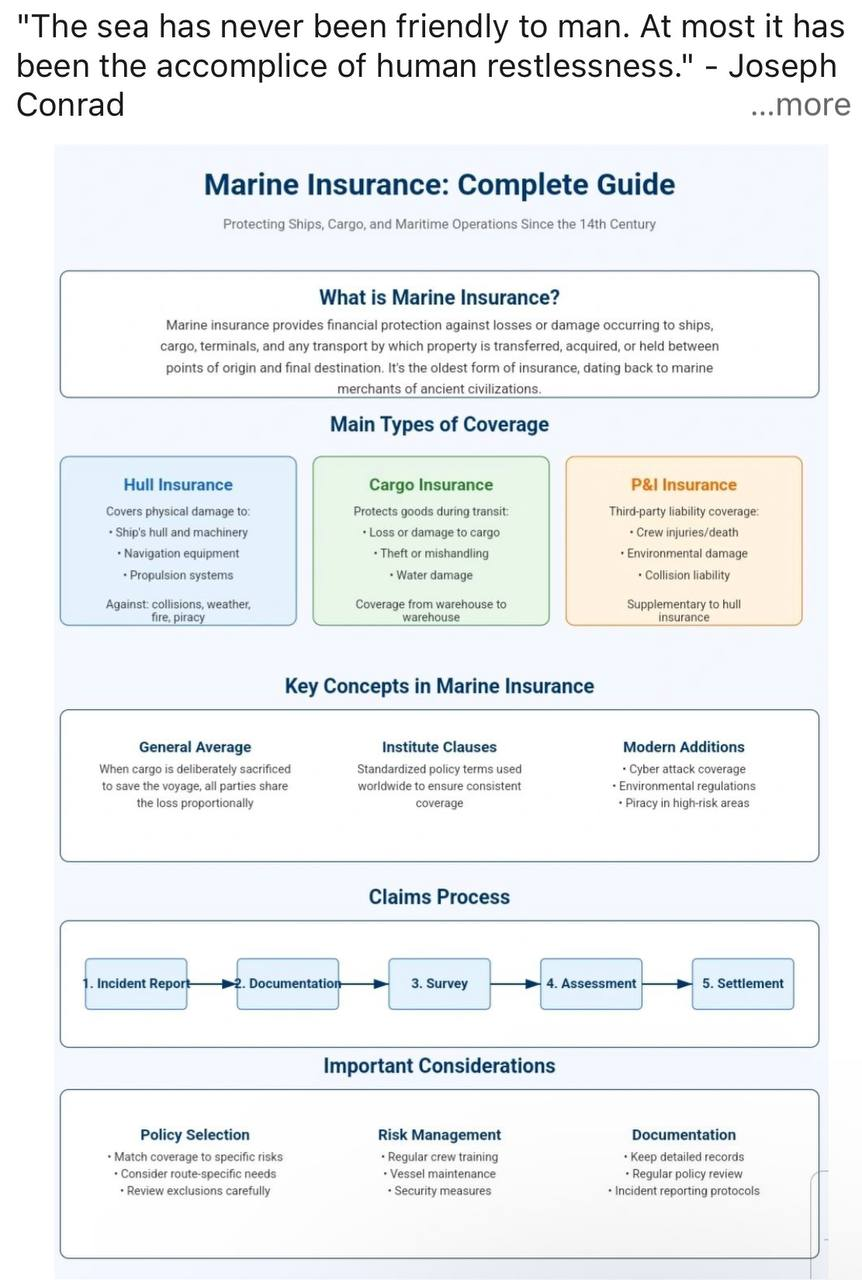
Infographic: the building blocks of marine insurance — how hull, cargo and P&I cover fit together, what General Average and Institute Clauses mean, and the five steps from incident report to settlement.
What is marine insurance?
Marine insurance provides financial protection against loss of or damage to ships, cargo, terminals and the means of transport used between the points of origin and destination.
Main types of cover
| Cover | What it protects | Typical risks |
|---|---|---|
| Hull & Machinery (H&M) | The ship's hull, machinery, navigation equipment and propulsion | Collision, heavy weather, fire, piracy |
| Cargo | Goods in transit, usually warehouse to warehouse | Theft, mishandling, water damage, loss |
| Protection & Indemnity (P&I) | Third-party liabilities of the shipowner | Crew injury or death, pollution, collision liability |
1. Hull insurance
- Covers physical damage to the ship's hull and machinery.
- Includes navigation equipment and propulsion systems.
- Protects against collisions, weather, fire and piracy.
2. Cargo insurance
- Protects goods during transit against loss or damage.
- Covers theft, mishandling or water damage.
- Normally attaches warehouse to warehouse.
3. P&I insurance
Third-party liability cover for crew injuries or deaths, environmental damage and collision liability. It is supplementary to hull cover, picking up the liabilities that H&M policies leave out.
Key concepts
- General Average — when cargo or ship's property is deliberately sacrificed (or extraordinary expense incurred) to save the common adventure, all parties to the voyage share the loss in proportion to their saved values.
- Institute Clauses — standardised policy wordings used worldwide so cover is consistent between insurers.
- Modern additions — cyber-attack cover, environmental-regulation exposures, and piracy/war risks in high-risk areas.
The claims process
- Incident report — notify owners, insurers and P&I correspondent promptly.
- Documentation — logbook extracts, photos, Letters of Protest, Bills of Lading, statements.
- Survey — an independent surveyor inspects the damage.
- Assessment — adjusters establish cause, liability and quantum.
- Settlement — the insurer pays under the policy terms.
Important considerations for the Master and owner
- Policy selection — match cover to the actual trade and risks, and read the exclusions carefully.
- Risk management — regular crew training, planned maintenance and security measures keep premiums and claims down.
- Documentation — keep detailed records and follow incident-reporting procedures; on the day of the claim, the log book is your best witness.
See also: Cargo Claims and Bills of Lading.
Marine insurance remains indispensable for managing risk in an unpredictable maritime environment.