Learning objectives
Identify the main shore-based departments, distinguish owner coordination from command, and explain how the DPA and CSO support safe vessel operation.
The organization chart
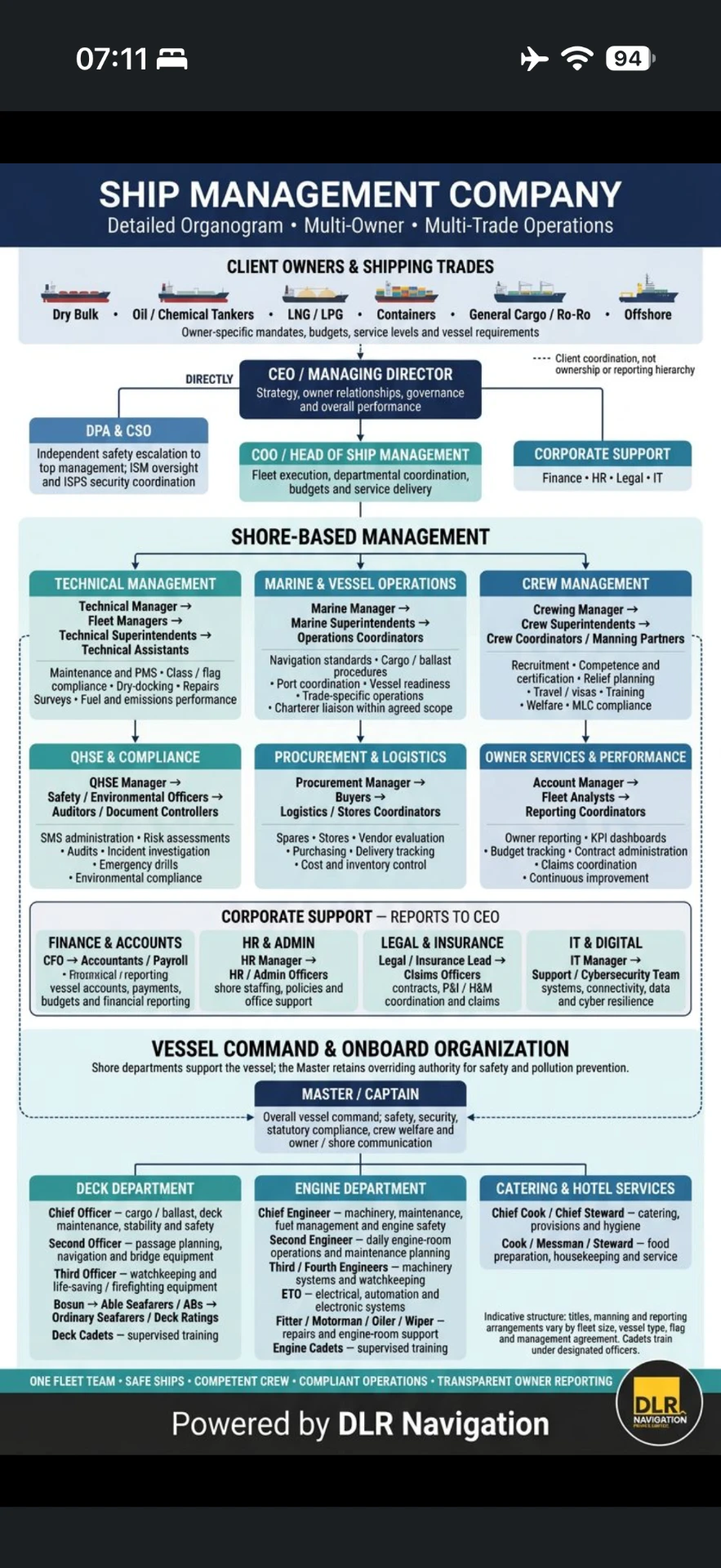
Organization chart supplied by Capt. Ivan Martsynenko. This is an indicative structure, not a prescribed staffing or reporting model.
Owners, management and the vessel
A ship-management company may manage vessels for several owners across dry bulk, tankers, gas carriers, containers, general cargo and offshore trades. The management agreement defines the services, budgets, reporting duties and commercial scope. Ownership is not the same as operational management: an owner may delegate specified services while retaining responsibilities under applicable law and contracts.
The CEO / Managing Director leads strategy, owner relationships and governance. The COO / Head of Ship Management coordinates fleet delivery, departmental work and budgets. Direct reporting arrangements vary between companies.
DPA and CSO: different functions
The Designated Person Ashore (DPA) provides a link between the company and those on board. Under ISM Code section 4, the designated person or persons must have direct access to the highest level of management and monitor the safety and pollution-prevention aspects of vessel operation, ensuring adequate resources and shore support. Direct access does not prescribe a particular organization-chart reporting line.
The Company Security Officer (CSO) performs the company-level duties under ISPS Code Part A section 11, including arrangements for ship security assessments, security plans and coordination with ship and port facility security officers. A company may combine roles where permitted and appropriate, but their responsibilities remain distinct.
Six shore-based departments
| Department | Typical roles | Operational focus |
|---|---|---|
| Technical management | Technical manager, fleet managers, technical superintendents and assistants | Planned maintenance, repairs, dry-docking, surveys, class and flag compliance, machinery performance |
| Marine and vessel operations | Marine manager, marine superintendents and operations coordinators | Navigation standards, cargo and ballast procedures, port coordination, vessel readiness and agreed charterer liaison |
| Crew management | Crewing manager, crew superintendents, coordinators and manning partners | Recruitment, certification, relief planning, travel, training, welfare and MLC compliance |
| QHSE and compliance | QHSE manager, safety and environmental officers, auditors and document controllers | Safety management system, risk assessments, audits, incident investigation, drills and environmental compliance |
| Procurement and logistics | Procurement manager, buyers and stores coordinators | Spares, stores, vendor evaluation, delivery tracking and inventory control |
| Owner services and performance | Account managers, analysts and reporting coordinators | Owner reports, budgets, contracts, performance measures and claims coordination |
These functions overlap. For a dry-docking project, technical management plans the work, procurement orders materials, operations coordinates the schedule, crewing arranges relief, QHSE reviews risks, and owner services reports progress and cost.
Corporate support
Finance and accounts handle vessel accounts, payments, payroll and financial reporting. HR supports shore staff and office administration. Legal and insurance teams coordinate contracts and claims with insurers and P&I clubs. IT supports connectivity, business systems, information security and cyber resilience. The chart shows these teams reporting to the CEO; actual arrangements depend on company size.
Vessel command and onboard organization
The Master has overall vessel command. ISM Code section 5.2 requires the safety management system to state the Master’s overriding authority and responsibility to make decisions concerning safety and pollution prevention and to request company assistance as necessary. Shore support and commercial instructions must not undermine this authority.
| Team | Typical responsibilities |
|---|---|
| Chief Officer | Cargo and ballast, stability, deck maintenance and safety duties assigned by the SMS |
| Second Officer | Passage planning, navigation and bridge equipment duties, subject to the vessel’s allocation of work |
| Third Officer | Watchkeeping and assigned life-saving and firefighting equipment responsibilities |
| Bosun and deck ratings | Deck work, maintenance and watch support within qualifications and assigned duties |
| Chief Engineer | Machinery management, maintenance, fuel systems and engine-department safety |
| Second Engineer | Daily engine-room operations and maintenance planning |
| Other engineers and ETO | Assigned machinery, electrical, automation and watchkeeping duties |
| Engine ratings | Machinery-space support, repairs and maintenance within qualifications |
| Catering team | Food preparation, provisions, hygiene and accommodation services |
| Cadets | Supervised training under designated officers; not substitutes for required certificated personnel |
Officer task allocations are common examples, not universal legal assignments. Actual manning follows the flag’s minimum safe manning requirements, applicable STCW qualifications, the SMS and vessel-specific needs. Job titles alone do not establish an individual’s authority or certification.
A practical escalation example
A vessel identifies a safety-critical machinery defect before departure. The Master and Chief Engineer assess operational consequences, notify technical management, and request resources. Marine operations adjusts the schedule; procurement arranges spares; QHSE helps manage risk and records. If normal channels do not secure adequate support, the DPA’s direct access to top management provides an escalation route. The Master retains the safety decision; a budget or schedule target is not permission to sail unsafely.
Related lessons
Official reference points
- IMO — International Safety Management Code: sections 4 and 5.2.
- IMO — SOLAS Convention: Chapter IX (ISM), Chapter XI-2 (security), Chapter V regulation 14 (manning).
- IMO — Maritime Security: ISPS Code, including company security duties.
These links identify the relevant instruments; the illustration does not prescribe a statutory company hierarchy.
Self-test
- What does the DPA’s direct access to highest management achieve?
- Are the DPA and CSO the same function?
- Which shore department normally leads machinery maintenance and dry-docking?
- Which department normally arranges crew relief and certification checks?
- Can owner or shore instructions override the Master’s safety and pollution-prevention decisions?
- Does this chart determine a ship’s minimum safe manning?
- Why must several departments coordinate a dry-docking project?
- Can a cadet automatically replace a required certificated officer?
Answer 1 — It supports effective escalation and helps ensure adequate resources and shore support for safety and pollution prevention; ISM section 4 requires direct access, not a fixed reporting title.
Answer 2 — No. The DPA links ship and company on safety and pollution prevention; the CSO has company security duties under the ISPS Code. Combining appointments does not merge the responsibilities.
Answer 3 — Technical management, working with the Chief Engineer and other departments.
Answer 4 — Crew management, in coordination with the vessel and relevant managers.
Answer 5 — No. The SMS must recognize the Master’s overriding authority for safety and pollution prevention under ISM section 5.2.
Answer 6 — No. Flag requirements, minimum safe manning documentation, STCW and vessel needs determine manning; the chart is indicative.
Answer 7 — Maintenance scope, purchasing, schedules, crew, risks and owner budgets are interdependent; one department cannot deliver the whole project alone.
Answer 8 — No. Cadets undertake supervised training and do not automatically satisfy required certificated positions.