This lesson follows the Wärtsilä Propulsion Netherlands document Bollard Pull Test Procedure (doc. no. W084828513, rev. A, issued 09/01/02). Original procedure reference; no public copy is provided.
What is bollard pull
Bollard pull is the static pulling force a vessel can exert on a fixed point at zero speed. It is the headline performance figure of a tug, anchor handler or other towing vessel, and charterers use it to decide whether the vessel can do a job.
To measure it, the vessel pulls on a towline fixed to a bollard ashore while a load cell records the force. Because the figure goes onto a certificate, the procedure fixes the conditions tightly. A test run in current, swell or shallow water would not show what the vessel can really deliver.
Steady and maximum bollard pull
The procedure defines two figures. They differ in the engine rating used and in how the pull is averaged.
| Steady bollard pull | Maximum bollard pull | |
|---|---|---|
| Prime mover rating | Manufacturer's recommended maximum continuous rating (MCR) | Manufacturer's recommended maximum rating that can be maintained for at least 1 hour (overload) |
| How the figure is taken | Average towing force held without any tendency to decline for at least 3 minutes | Maximum average pull recorded over a period of one minute |
| Can the test be omitted? | No, it is the certified figure | Yes, the overload test may be omitted |
In plain terms, steady pull is what the vessel can keep up, and maximum pull is what it can reach briefly when the engines are pushed above continuous rating. A pull that is still falling after a few minutes is not a steady figure.
Test set-up
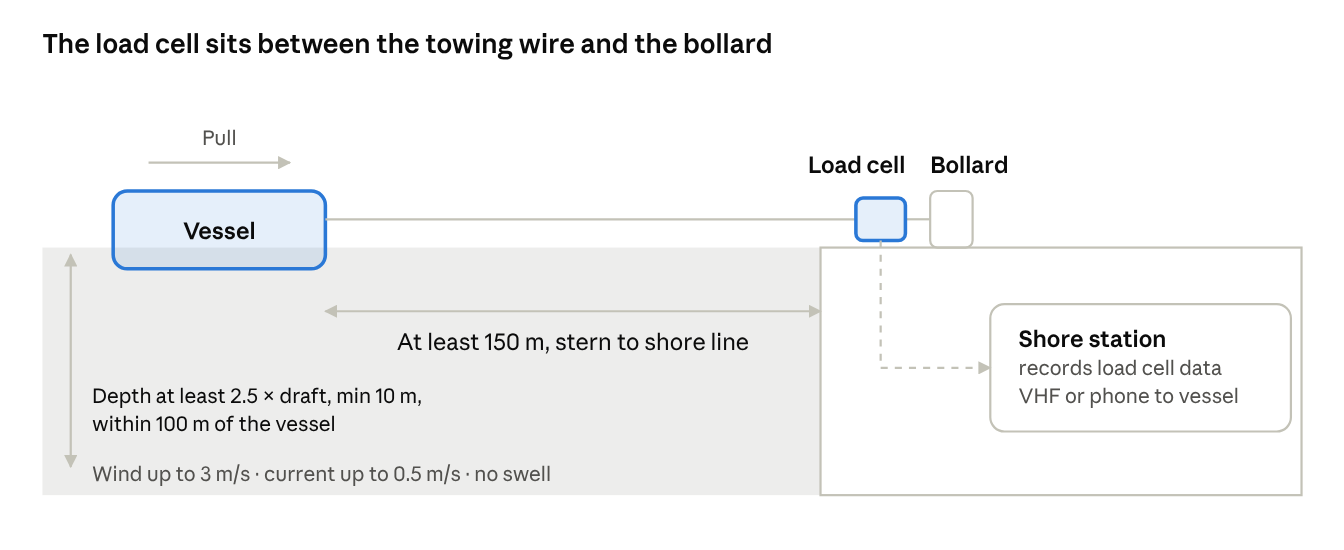
The vessel pulls on a wire led to a bollard ashore, with the load cell fitted between the wire's eye and the bollard. Wind, current and swell limits apply to the whole site, and the shore station keeps a VHF or telephone link to the vessel throughout.
Required test conditions
The procedure sets limits on the site, the vessel and the weather. Check every line before the first pull.
| Item | Requirement | Why it matters |
|---|---|---|
| Towline length | At least 150 m, measured between the vessel's stern and the shore line | A long line keeps the vessel's own wash away from the pull and gives a realistic line angle |
| Water depth | At least 2.5 times the vessel's overall draft, and at least 10 m, within a radius of 100 m | Shallow water changes propeller flow and so changes the pull |
| Displacement | Corresponding to towing operation conditions | The pull must match the loading the vessel actually tows in |
| Trim | Even keel, or trim by the stern of no more than 2 % of vessel length | Trim changes propeller immersion and thrust |
| Wind | No more than 3 m/s (about 6 knots) | Wind loads the hull and can push the vessel off the line |
| Current, swell | Current no more than 0.5 m/s (about 1 knot); no swell or significant waves | Moving water adds to or subtracts from the measured force |
Worked example. A vessel 40 m long drawing 5 m needs at least 12.5 m of water (2.5 × 5 m) and may be trimmed by the stern by no more than 0.8 m (2 % of 40 m). A vessel drawing 3 m needs 7.5 m by the ratio, but the 10 m minimum applies instead.
The load cell
- Approved by a classification society and calibrated at least once a year
- Accurate to ± 2 % within a temperature range of −10 °C to +40 °C
- Its indication range must not be more than 50 % above the maximum estimated bollard pull, so the readings stay in the accurate part of its scale
- Fitted between the eye of the towing wire and the bollard
What is recorded
These items are measured continuously and simultaneously against time:
- Ambient conditions
- Bollard pull
- Prime mover delivered power and speed
- Pitch angle, for a controllable pitch propeller (if applicable)
- Steering angle needed to compensate yawing of the vessel, because it can influence the result
Recording against one time base lets the surveyor see which engine setting, pitch and rudder angle produced each value of pull. A VHF or telephone link must be kept open for the whole test between the vessel and the people monitoring the load cell ashore.
Safety limits and common pitfalls
The procedure sets one hard safety limit: maximum bollard pull must not be tested beyond 50 % of the breaking strength of the towing wire. A wire with a breaking strength of 100 t may be loaded to no more than 50 t during the test.
Points to watch on the day:
- Wind or current creeping above the limits during a long test. Check them throughout, not only at the start.
- Reading the steady figure too early. The pull must be held without any tendency to decline for at least 3 minutes.
- Overlooking the rudder or steering angle needed to hold the vessel straight. It must be recorded.
- Using a load cell with an expired calibration or the wrong range.
- Everyone clear of the towline and the bollard area. A parted wire under load is lethal (general good practice, not stated in the procedure).
The certificate and conditions not met
The certified steady bollard pull is the average towing force held for at least 3 minutes without decline, with the engines at the maximum continuous rating.
If one or more conditions cannot be met — for example the water is shallower than required or the wind is above 3 m/s — the test is not simply thrown out. The procedure requires that this fact is noted on the certificate, so anyone reading the figure knows it was not obtained under full standard conditions.
Key numbers
| Item | Value |
|---|---|
| Minimum towline length | 150 m |
| Minimum depth | 2.5 × draft, and not less than 10 m, within 100 m |
| Maximum trim by the stern | 2 % of vessel length |
| Maximum wind | 3 m/s |
| Maximum current | 0.5 m/s |
| Load cell accuracy | ± 2 %, −10 °C to +40 °C |
| Load cell calibration | At least once a year |
| Steady pull averaging time | At least 3 minutes |
| Maximum pull averaging time | 1 minute |
| Overload rating hold time | At least 1 hour |
| Pull limit | 50 % of towing wire breaking strength |
Test yourself
- Which engine rating is used for the steady bollard pull test?
- A vessel is 60 m long. What is the largest permitted trim by the stern?
- A vessel drawing 6 m: what is the minimum water depth?
- Where is the load cell fitted?
- The wire breaks at 80 t. What is the highest pull you may test to?
- A 2 m/s current is present at the test site. What must be done about the certificate?
- The manufacturer's recommended maximum continuous rating (MCR).
- 1.2 m (2 % of 60 m).
- 15 m (2.5 × 6 m, which is above the 10 m minimum).
- Between the eye of the towing wire and the bollard.
- 40 t (50 % of 80 t).
- The current exceeds the 0.5 m/s limit, so the test does not comply, and a notation of this must be made on the certificate.