Centrifugal Separators: Purifiers and Clarifiers in the Engine Room
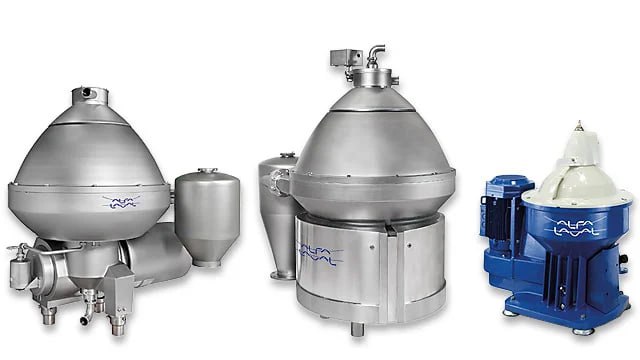
No oil goes straight from the bunker barge to the main engine. Between the storage tank and the injector stands the centrifugal separator — the engine room's most diligent watchkeeper. Modern residual fuels carry catalytic fines, water, rust and sludge; lubricating oil picks up combustion soot, metal particles and water in service. Left in the oil, these destroy fuel pumps, injectors, piston rings and bearings. The disc-stack centrifuge removes them by spinning the oil at high speed so that centrifugal force — thousands of times gravity — throws the heavy contaminants outward.
How the Disc-Stack Centrifuge Works
Oil enters the rotating bowl and travels up through a stack of conical discs. The discs split the flow into thin layers, so a dirt particle only has to travel a fraction of a millimetre before it meets a disc surface, where it slides outward to the bowl periphery. Clean oil discharges from the top; solids collect as sludge in the bowl space and are ejected at intervals by a sludge discharge cycle.
Purifier or Clarifier?
- Purifier — separates two liquids (oil and water) plus solids. It runs with a water seal and a gravity disc (ring dam) sized to the oil's density, which fixes the oil–water interface. Correct gravity disc selection is the single most important adjustment on the machine: too large and oil escapes with the water; too small and water carries over into the clean oil.
- Clarifier — removes solids only from oil that is essentially water-free (typically lubricating oil). No gravity disc, no water seal.
Modern self-cleaning designs, like the Alfa Laval units pictured, often run in ALCAP mode: no gravity disc at all, with a water transducer controlling the interface automatically — a significant relief when switching between fuels of different densities.
Watchkeeping Practice
- Heat the oil — separation efficiency rises steeply with temperature (typically 90–98 °C for heavy fuel oil). Never cold-separate.
- Run at reduced throughput — two separators in parallel at half flow clean better than one at full flow. The rated capacity is a sales figure, not an operating target.
- Check the water seal before starting a purifier; losing the seal means oil to the sludge tank.
- Watch sludge discharge intervals — too frequent wastes oil; too rare lets sludge re-enter the clean oil stream. Judge by the nature of the fuel, not the manual alone.
- Log the vibration — a separator that begins to vibrate is telling you the bowl needs cleaning. Do not silence it and carry on.
Safety Notes
A bowl rotating at several thousand rpm stores enormous energy. Never open it before it has stopped completely, follow the maker's overhaul intervals for the bowl spindle and lock ring, and keep the sludge tank vent clear. Water in the fuel system downstream of the separator is an alarm condition — trace it back to gravity disc selection, a broken water seal, or a malfunctioning drain valve before returning the machine to service.
The separator asks for heat, patience and a steady flow. Give it all three, and the main engine will never know how dirty the bunker really was.