The beacon in one line. An EPIRB (Emergency Position-Indicating Radio Beacon) is the ship's last voice: when everything else is lost, it sends a coded 406 MHz distress alert through satellites so a Rescue Coordination Centre knows who you are and where you are.
Rules and figures last verified on 1 November 2026 against official IMO, SOLAS and Cospas-Sarsat texts — see Sources checked at the end of the lesson.
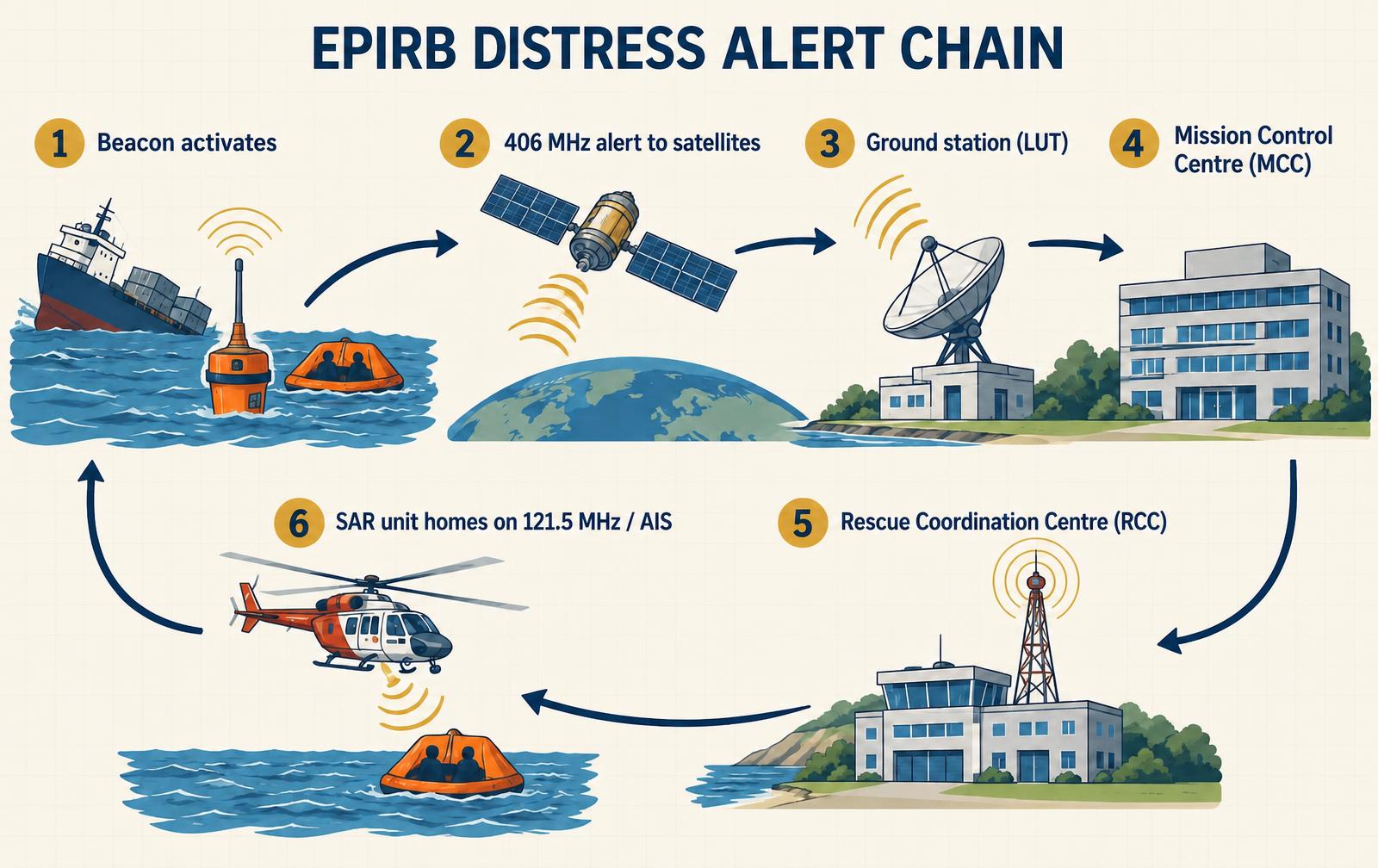
Figure 1 — The EPIRB alert chain, from beacon to rescue unit.
How the alert travels
| Step | Who | What happens |
|---|---|---|
| 1 | Beacon | Activated manually, or automatically when the float-free unit is released and floats up. It transmits a digital burst on 406 MHz roughly every 50 seconds. |
| 2 | Satellites | Cospas-Sarsat satellites in low, medium and geostationary orbit pick up the burst. |
| 3 | Local User Terminal (LUT) | A ground station receives the relay, decodes the beacon identity and works out (or reads) its position. |
| 4 | Mission Control Centre (MCC) | Validates the alert, matches it to the beacon registration and routes it to the right SAR authority. |
| 5 | Rescue Coordination Centre (RCC) | Calls the ship's emergency contacts, alerts nearby vessels and tasks aircraft or lifeboats. |
| 6 | SAR unit | Flies to the reported position, then homes on the beacon's 121.5 MHz signal — and on newer beacons its AIS locating signal — to find the survivors. |
The beacon's message carries a unique 15-character hexadecimal ID. That ID links to the registration record — vessel name, MMSI, call sign, owner and emergency contacts — which is why an unregistered or out-of-date beacon slows the rescue.
Why 121.5/243 MHz beacons were retired
Old analogue beacons on 121.5/243 MHz carried no identity and could only be located to roughly 20 km. They also produced a flood of false alerts from aircraft and other sources on the same frequency.
Cospas-Sarsat stopped processing 121.5/243 MHz signals by satellite on 1 February 2009. An alert from such a beacon now reaches nobody unless a passing aircraft or ship happens to hear it. If you find one on board, it is not a GMDSS EPIRB.
121.5 MHz survives only as a low-power homing signal inside a 406 MHz beacon, for the last few miles of the search.
406 MHz: identity, accuracy and coverage
The 406.0–406.1 MHz band is reserved worldwide for distress beacons; nothing else may transmit there.
| Satellite layer | What it gives | Limitation |
|---|---|---|
| LEOSAR (low-earth polar orbit) | Global coverage; position from Doppler shift, typically within a few kilometres, even without GPS | Not continuous — you may wait for a satellite pass, so the first alert can take an hour or more |
| GEOSAR (geostationary) | Near-instant alert | No Doppler position — you get a location only if the beacon has a GNSS receiver; weak near the poles |
| MEOSAR (navigation satellites — Galileo, GPS, GLONASS, BeiDou) | Near-instant detection and an independent position, usually within minutes; early operational use since December 2016, initial operational capability declared in April 2023, and gradually replacing LEOSAR | Best results with newer ground stations; still benefits from a GNSS-equipped beacon |
A GNSS-equipped EPIRB (GPS fitted since the late 1990s) encodes its own position in the alert, typically to within about 100 metres. That position reaches the RCC on the first burst received — the single biggest improvement in time-to-rescue.
Master's note. An EPIRB inside a wheelhouse, under a canopy or lying flat in a liferaft may struggle to get a GNSS fix. The alert still goes out, but with a poorer position. Mount and deploy it with a clear view of the sky.
Category I and Category II beacons
| Category I | Category II | |
|---|---|---|
| Release | Float-free from a bracket with a hydrostatic release unit | Taken from its bracket by hand |
| Activation | Automatic once floating — or manual | Manual (some models also switch on when wet after removal) |
| Typical use | Merchant ships under SOLAS | Small craft and recreational vessels |
The Category I/II labels come from US regulation, but the idea is universal: a SOLAS ship needs the float-free, automatically activated type — a manual-only beacon does not meet SOLAS IV/7.1.5, which requires the EPIRB to float free if the ship sinks, activate automatically when afloat, be manually releasable and be activated manually.
Float-free arrangement
Most ships carry the EPIRB in a float-free bracket with a hydrostatic release unit (HRU). If the ship sinks, water pressure fires the HRU, the beacon floats clear and switches itself on when wet. The IMO standard requires the float-free arrangement to release the beacon before it reaches a depth of 4 metres (MSC.471(101)); most HRUs fire at around 1.5–4 m.
Check at every inspection:
- the beacon is in the bracket with its lanyard not tied to the ship;
- the HRU and the beacon battery are within their expiry dates (disposable HRUs are typically replaced every two years);
- nothing above the bracket could trap a floating beacon;
- vessel name, MMSI and beacon ID are marked on the unit.
Carriage and the rules behind it
| Requirement | Where it comes from |
|---|---|
| Every SOLAS ship carries an EPIRB in an easily accessible position, ready to be released by hand and carried by one person into a survival craft, able to float free and activate automatically, and to be activated manually | SOLAS IV/7.1.5 (chapter IV as rewritten by MSC.496(105), in force 1 January 2024) |
| Performance standard for float-free 406 MHz EPIRBs — at least 48 hours' operation, GNSS position, 121.5 MHz homing and an AIS locating signal (shown as "EPIRB ACTIVE" with the beacon's 15-character ID) for beacons installed on or after 1 July 2022 | IMO resolution MSC.471(101) |
| Annual test of operational efficiency — emission on the operating frequencies, coding and registration — on board or at an approved station; for cargo ships within three months before the expiry date, or within three months before or after the anniversary date, of the Cargo Ship Safety Radio Certificate (passenger ships: within three months before the Passenger Ship Safety Certificate expires) | SOLAS IV/15.9.1; guidance in MSC.1/Circ.1040/Rev.2 |
| Maintenance at an approved shore-based facility at intervals not exceeding five years | SOLAS IV/15.9.2; guidelines in MSC/Circ.1039 |
| Registration of the beacon's GMDSS identity, with the information available to RCCs 24 hours a day | SOLAS IV/5-1 (arranged by each flag State) |
Always check the flag State's own instructions; some require additional or more frequent checks.
Routine checks
- Monthly (good practice) — visual check of the bracket, HRU date, battery date and labelling; run the beacon's self-test following the manufacturer's procedure. The self-test does not send a real alert. This interval comes from company and flag-State practice, not SOLAS itself.
- Annually (SOLAS IV/15.9.1) — test by an authorised radio surveyor, normally at the annual radio survey, covering the emission, coding and registration.
- Every five years at most (SOLAS IV/15.9.2) — maintenance at an approved shore-based facility, including battery replacement where due.
- On any change of ownership, flag, name, MMSI or emergency contact — update the registration the same day.
False alerts
A false alert costs SAR time and money and can lead to fines for the owner. If the beacon goes off by accident:
- Stop the transmission immediately — switch it off following the manufacturer's procedure. Do not throw it overboard or simply hide it.
- Tell the local RCC at once by any means — DSC, satellite phone, VHF or the ship's company — and give the beacon ID, ship name, MMSI and position. IMO guidance also asks you to inform the nearest Cospas-Sarsat Mission Control Centre (MSC.1/Circ.1040/Rev.2).
- Record the event in the GMDSS radio log and report it to the company.
EPIRB and SART — not the same job
| EPIRB | SART (radar or AIS) | |
|---|---|---|
| Purpose | Raises the alert ashore through satellites | Helps nearby ships and aircraft locate survivors on scene |
| Range | Global | Line of sight — a few nautical miles to tens of miles from aircraft |
| Shows up on | RCC screens | X-band radar as a line of 12 dots, or AIS displays |
An EPIRB tells the world you are in trouble; a SART helps the rescuer find the raft in the last few miles. For the SART, VHF and MF/HF sets on the bridge, see GMDSS Bridge Radios: VHF, MF/HF and SART.
Sources checked
Figures and rule references in this lesson were last verified on 1 November 2026 against:
- IMO resolution MSC.496(105) — revised SOLAS chapter IV, in force 1 January 2024 (regulations IV/2, 5-1, 7.1.5 and 15.9).
- IMO resolution MSC.471(101) — performance standards for float-free 406 MHz EPIRBs (48 h battery, GNSS, 121.5 MHz homing, AIS locating signal, release before 4 m).
- MSC.1/Circ.1040/Rev.2 — guidelines on annual testing of EPIRBs, including accidental transmissions.
- Cospas-Sarsat: 121.5 MHz phase-out and transition to MEOSAR.
Always follow your flag State's instructions, which may add to these minimums.
Self-test
- List the six steps in the EPIRB alert chain.
Answer 1
Beacon → satellite → Local User Terminal (LUT) → Mission Control Centre (MCC) → Rescue Coordination Centre (RCC) → SAR unit.
- From what date did Cospas-Sarsat stop satellite processing of 121.5/243 MHz beacons?
Answer 2
1 February 2009.
- Why is a 406 MHz beacon found so much faster than the old 121.5 MHz type?
Answer 3
It sends a digital identity linked to a registration record, is located far more precisely, and is received through several satellite systems — with an encoded GNSS position on the first burst if it has a GNSS receiver.
- What does a geostationary (GEOSAR) satellite give you, and what can it not do on its own?
Answer 4
A near-instant alert. It cannot work out the position by itself; the location comes only from the beacon's GNSS receiver.
- What is the purpose of the 121.5 MHz signal in a modern EPIRB?
Answer 5
Homing — rescue units use it for direction-finding in the final stage of the search.
- What extra locating signal must float-free EPIRBs installed from 1 July 2022 carry?
Answer 6
An AIS locating signal (MSC.471(101)).
- At roughly what depth does the hydrostatic release unit free the beacon?
Answer 7
Before the beacon reaches a depth of 4 metres (MSC.471(101)). Most units fire at about 1.5–4 m.
- What is the maximum interval for shore-based maintenance of an EPIRB?
Answer 8
Five years, at an approved shore-based facility (SOLAS IV/15.9.2).
- The vessel changes flag and name. What must happen to the EPIRB?
Answer 9
Its registration must be updated with the new Administration's registry. If the beacon is reprogrammed for the new flag, its identity changes too.
- The EPIRB is set off by accident in port. What do you do?
Answer 10
Switch it off following the manufacturer's procedure, notify the nearest RCC/MRCC immediately with the beacon ID and ship details, and log and report the event.
- Which EPIRB category does a SOLAS cargo ship need, and why?
Answer 11
Category I — float-free and automatically activated, because SOLAS IV/7.1.5 requires the beacon to float free and switch on by itself if the ship sinks.