The rule in one line. When something is deliberately sacrificed, or money is spent, to save the whole voyage from a real danger, the loss is not borne by whoever suffered it — it is shared by everyone whose property was saved, in proportion to the value saved.
Rule numbers and references last verified on 1 November 2026 against the official York-Antwerp Rules 2016 and CMI texts — see Sources checked at the end of the lesson.
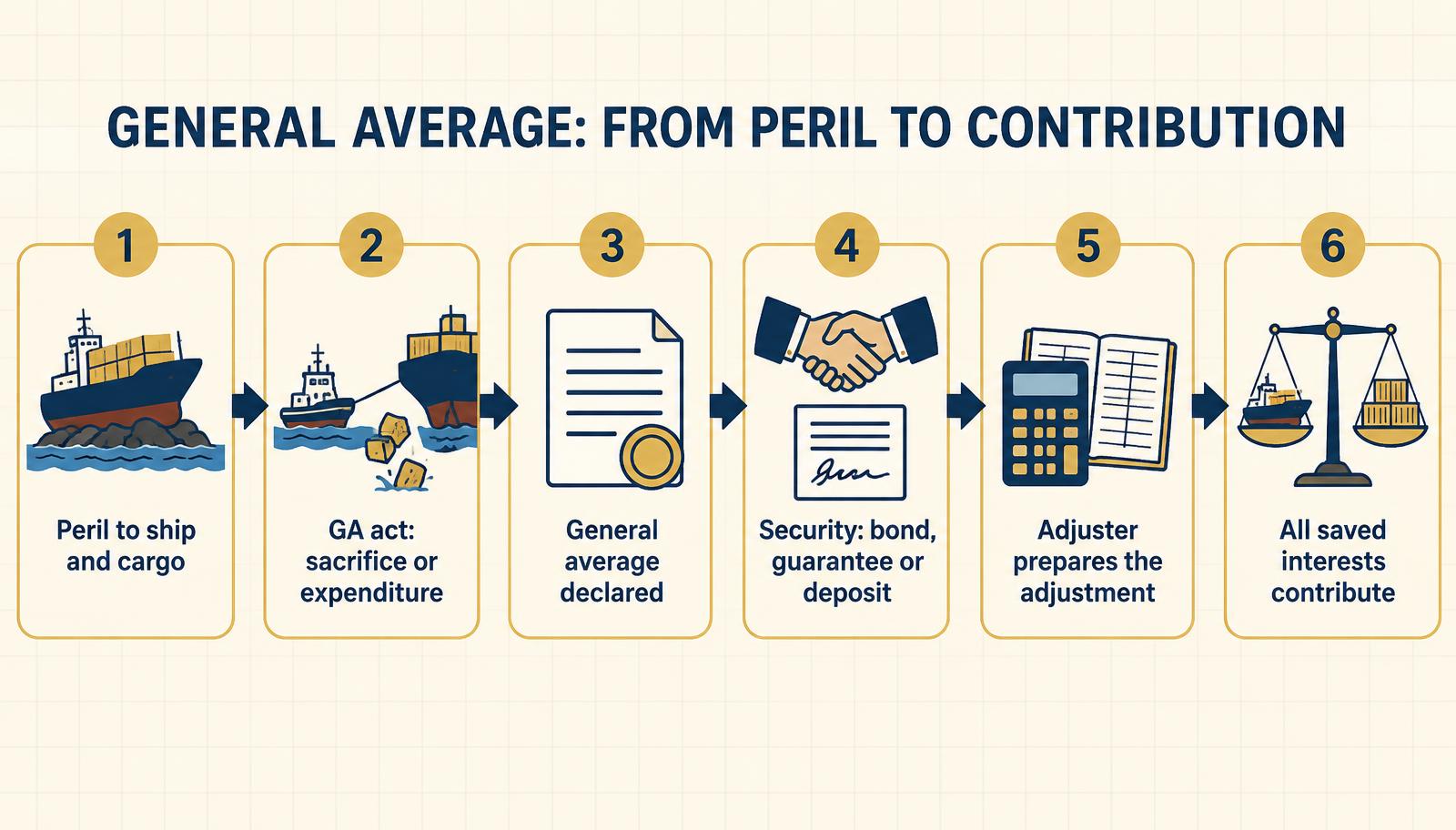
Figure 1 — The general average process, from the incident to the final contribution.
Three forms of general average
| Form | Meaning | Examples |
|---|---|---|
| General average act | The deliberate action taken for the common safety | Refloating a stranded ship; beaching a leaking ship to stop her sinking |
| General average sacrifice | Property deliberately given up or damaged by that action | Jettisoning cargo to lighten a grounded ship; engine, propeller or hull damage caused while working to refloat; slipping anchor and cable to avoid collision |
| General average expenditure | Money spent because of the action | Tugs and salvage; discharging cargo to refloat or repair; port-of-refuge charges, agency and survey fees, storage; crew wages and stores while repairs are made at a port of refuge (subject to the Rules applied); the adjuster's fee |
A port of refuge is any port where general average expenditure is incurred. It can even be the loading port, if the ship has to return there — for example after her cargo has shifted.
The five tests
The test comes from Rule A of the York-Antwerp Rules 2016: "There is a general average act when, and only when, any extraordinary sacrifice or expenditure is intentionally and reasonably made or incurred for the common safety for the purpose of preserving from peril the property involved in a common maritime adventure." The Rule Paramount adds that nothing is allowed unless it was reasonably made or incurred. For a sacrifice or expenditure to count as general average, all five tests must be met:
- Extraordinary. Ordinary running costs do not count. Pushing the engines hard while afloat to avoid going aground is ordinary; overworking them while aground in an attempt to refloat is extraordinary.
- Reasonable. Jettisoning enough deck cargo to refloat is reasonable; jettisoning all of it when half would do is not.
- Intentional. The act must be deliberate, not inevitable. Running aground by accident is not a GA act; deliberately beaching to avoid sinking, or refloating after an accidental grounding, can be.
- A real peril. The danger must be real and substantial, though not necessarily immediate. A ship drifting without power in mid-ocean is in peril even in calm weather. A sound ship running for shelter ahead of a forecast storm is taking a precaution, not a GA act.
- For the common safety. The danger must threaten all the interests. If a reefer ship's refrigeration fails, only the cargo is at risk — the ship could carry on safely, so a diversion to repair it is not GA. A fire in the hold threatens everyone, so a diversion to a port of refuge almost certainly is.
Master's note. The line between a GA act and a prudent precaution is fine, and it is decided later by the adjuster from your records. Log the danger, the options you considered and why you chose this one — at the time, not afterwards.
Which rules apply
General average is normally adjusted under the York-Antwerp Rules (YAR). They are not law; they apply because the contract of carriage — the charter party or bill of lading — says so.
| Edition | Where you meet it |
|---|---|
| YAR 1994 | Still found in many older charter parties and bills of lading |
| YAR 2004 | Less favourable to shipowners (for example on salvage and crew wages at a port of refuge), so shipowners' bodies did not recommend it and it was little used |
| YAR 2016 | The current edition, adopted by the Comité Maritime International in New York in May 2016, with a technical change to the interest provision (Rule XXI) made at Antwerp in October 2022. BIMCO's General Average Clause adjusts GA under YAR 2016 in London unless another place is agreed |
Always check the GA clause in the bill of lading and charter party for the edition. If the contract names no rules, the law of the place where the voyage ends may decide — and some carriers specify national rules instead, such as the China Council for the Promotion of International Trade's General Average Adjustment Rules (the Beijing Rules, revised in 2022).
Declaring general average
- Who declares? In practice the shipowner (the carrier). It holds the lien on the cargo and usually appoints the average adjuster. A cargo owner whose goods were sacrificed — jettisoned, for example — does not declare; its loss is credited in the adjustment.
- When? As soon as practicable after the GA act — often while the ship is still at the port of refuge — and in any case before the cargo is delivered at destination, because the shipowner's lien is exercised there.
- How? In line with local law and custom. Often it is simply the owner's notice to cargo interests that contributions will be collected; in some countries it involves lawyers or a court. The average adjuster advises on the procedure.
- Then what? The adjuster estimates the loss, sets the security each consignment must give, and starts collecting evidence. A full adjustment can take months or even years.
General average security
The shipowner has a lien on the cargo in its possession for the cargo's share of general average. Because the final figures take so long, the lien is used to obtain security before delivery, not the full contribution. The usual package is a bond signed by the cargo owner or receiver plus either a cash deposit or — if the cargo is insured — an underwriter's guarantee accepted in place of the deposit (CMI GA Guidelines, 2022).
Under Rule D of the York-Antwerp Rules, general average still applies even if the casualty was caused by one party's fault — but that party's remedies and defences are preserved. Security must still be given, and cargo may later refuse to contribute if the carrier was in actionable breach of contract; giving security does not give up that defence.
| Security | Given by | What it is |
|---|---|---|
| Average bond | Cargo receiver | A signed promise to pay its proper share of GA, salvage and special charges once assessed — today often on the standard bond form recommended by the CMI, IUMI and ICS (2022); the older Lloyd's Average Bond (LAB 77) is still met |
| Average guarantee | Cargo underwriter | The insurer's guarantee to pay the cargo's share, so the goods can be released without a cash deposit — the CMI publishes a recommended guarantee form too |
| General average deposit | Cargo receiver | A cash deposit against a deposit receipt. Under YAR 2016 Rule XXII it goes straight to the average adjuster, into a special interest-earning account held separately from the adjuster's own funds |
The adjuster appointed by the declaring party arranges the security — often salvage security too. The Master, or the agent on the Master's behalf, collects it, and no cargo is released until it is in hand.
Special (particular) charges are costs spent for one consignment only — not for the common adventure. They are not general average; the carrier recovers them from that consignment's receiver and holds a lien on the goods for them.
Deck cargo
| Situation | Position under the York-Antwerp Rules |
|---|---|
| Deck cargo jettisoned, carried on deck by a recognised custom of the trade (timber deck cargo, containers on a container ship) | It is a GA sacrifice — the owner is compensated by the others (Rule I) |
| Deck cargo jettisoned, not carried on deck by custom | No GA claim for the cargo owner (Rule I) |
| Deck cargo saved by a GA act | Its owner contributes like everyone else — bills of lading usually say so expressly |
| Cargo wrongly stowed on deck without the shipper's consent, then jettisoned | The shipowner is fully liable to the cargo owner for breach of contract |
The Master's steps at a port of refuge
A loaded ship grounds on a river shoal, is refloated, and is towed to a terminal for a diver survey; some cargo is discharged there. On arrival the Master should:
- Report safe arrival to the owner, the charterer and the agent.
- Call in the P&I correspondent and work with them and the agent throughout.
- Note protest, reserving the right to extend it.
- Hold the cargo until the agent has collected the GA security the adjuster requires from each receiver.
- Work with the general average surveyor and gather the evidence — logbooks, engine and course recorders, VDR data, photographs, statements and survey reports.
- Write a full incident report, with copies for every interested party including the adjuster.
- Extend the protest when the survey reports are in, and send a copy to the owners.
The owners usually appoint the adjuster. Separate surveyors may attend for hull and machinery underwriters, the charterer, cargo owners, the adjuster and the P&I club — anyone with an insurable interest is likely to be represented.
A worked contribution
A simplified example after a refloating:
| Interest | Value saved at the end of the voyage |
|---|---|
| Ship | US$ 20,000,000 |
| Cargo | US$ 28,000,000 |
| Freight at risk | US$ 2,000,000 |
| Total contributory value | US$ 50,000,000 |
The allowed general average — tugs, port-of-refuge costs and damage to the engine during the refloat — comes to US$ 1,000,000. The rate is 1,000,000 ÷ 50,000,000 = 2 %:
- ship pays US$ 400,000;
- cargo pays US$ 560,000, shared among the consignments by value;
- freight pays US$ 40,000.
In a real adjustment the amounts "made good" to each party are added back into the contributory values (YAR 2016 Rule XVII), but the principle is the same: everyone saved pays the same percentage.
Related lessons
- Marine Insurance: Hull, Cargo and P&I Cover — who pays for what, and where general average sits.
- Bills of Lading — where the GA clause is found.
- Cargo Claims — protests, evidence and the Hague-Visby Rules.
Sources checked
Rule numbers and references in this lesson were last verified on 1 November 2026 against:
- York-Antwerp Rules 2016 (CMI, English text) — Rule of Interpretation, Rule Paramount, Rule A, Rule I (jettison), Rule XVII (contributory values), Rule XXI (interest) and Rule XXII (cash deposits).
- CMI — York-Antwerp Rules — the 2016 adoption, the 2022 technical change and earlier editions.
- BIMCO General Average Clause — YAR 2016, adjusted in London unless otherwise agreed.
- CMI GA Guidelines and security forms — guidelines (2nd edition, October 2022) and the bond and guarantee forms approved by the CMI, IUMI and ICS.
The York-Antwerp Rules apply only as far as the contract of carriage incorporates them. Check the GA clause in your charter party and bills of lading, and take advice from the average adjuster.
Self-test
- Name the three forms general average can take.
Answer 1
General average acts, general average sacrifices and general average expenditure.
- List the five tests a sacrifice or expenditure must meet.
Answer 2
Extraordinary, reasonable, intentional, a real peril, and for the common safety.
- A sound ship deviates to shelter from a forecast storm. General average?
Answer 3
No. It is a prudent precaution, not action taken in the face of a peril.
- A reefer's refrigeration plant fails and she diverts for repairs. General average?
Answer 4
No. Only the cargo is threatened, so the action is not for the common safety of ship and cargo.
- Why do the York-Antwerp Rules apply at all?
Answer 5
Because the contract of carriage — charter party or bill of lading — says so. They are not law in themselves.
- Which edition of the York-Antwerp Rules is current, and which older one is still widely found in contracts?
Answer 6
YAR 2016 is current; YAR 1994 is still widely found in older contracts.
- When must general average be declared?
Answer 7
As soon as practicable after the GA act, and in any case before the cargo is delivered at destination — the shipowner's lien is exercised there.
- What is the difference between an average bond and an average guarantee?
Answer 8
The bond is signed by the cargo receiver, promising to pay its share; the guarantee is given by the cargo underwriter, so the goods can be released without a cash deposit.
- Containers stowed on deck of a container ship are jettisoned to save the ship. Can their owner claim in general average?
Answer 9
Yes — containers on a container ship are carried on deck by a recognised custom of the trade.
- Ship, cargo and freight are worth US$ 60 million together, and the allowed general average is US$ 1.2 million. What does a cargo owner with goods worth US$ 3 million pay?
Answer 10
Rate = 1.2 ÷ 60 = 2 %. The cargo owner pays US$ 60,000 (in this simplified example).