Reading the supplied notes critically
This original companion reviews all 14 pages, questions A1–A140, of the uploaded “Section A: Maritime treaty instruments”. The page footer identifies The Shipmaster’s Business Self-Examiner; no author or edition is established from the supplied extract. Many answers expressly cite 2015–2016 information. Treat it as a historical study outline, not a current treaty-status book, consolidated convention or operating authority. The document, page images and original answer tables are not redistributed.
The central skill is not memorising an organisation's member count. It is tracing the applicable instrument, its legal force, the correct edition, the relevant State's position and the actual ship. This lesson uses official sources reviewed on 7 November 2026 and does not replace flag instructions, current treaty text or jurisdiction-specific legal advice.
Who develops the rules—and who enforces them?
| Organisation | Maritime role | Important distinction |
|---|---|---|
| IMO — International Maritime Organization | UN specialised agency for shipping safety, security, pollution prevention, facilitation and maritime legal matters | IMO develops instruments; it does not operate a global ship-inspection force |
| ILO — International Labour Organization | International labour standards, including the Maritime Labour Convention, 2006 | Tripartite: governments, employers and workers participate |
| United Nations / law of the sea framework | UNCLOS sets maritime zones, navigation rights and State duties | UNCLOS is not an IMO convention |
| ITU — International Telecommunication Union | Radio spectrum and satellite-orbit regulatory framework | Radio Regulations are distinct from SOLAS ship-carriage requirements |
| WHO — World Health Organization | International Health Regulations and public-health measures at points of entry | Health requirements are not settled by a safety certificate alone |
| CMI — Comité Maritime International | Maritime law harmonisation, including York-Antwerp Rules | York-Antwerp Rules are not an IMO treaty; contractual incorporation matters |
IMO's Assembly, Council and main committees—MSC, MEPC, Legal, Technical Cooperation and Facilitation—have different functions. MSC/MEPC sub-committees support technical work. The source's 171 members and 32-member Council are historical: the reviewed IMO information gives 176 Member States and a 40-member Council. Arsenio Dominguez began his first term as Secretary-General on 1 January 2024. Counts and appointments are dated facts, not permanent exam answers; use IMO's current pages before quoting them.
Flag States implement and enforce applicable obligations on their ships. Recognised organisations may carry out delegated work within their authorisation; delegation does not erase flag responsibility. Port and coastal States have powers under the applicable treaty and national law, subject to jurisdictional limits. IMO membership is not the same as being a party to a particular convention, protocol or optional annex.
Convention, protocol, resolution, code or guidance?
| Instrument | How to assess its effect | Example |
|---|---|---|
| Convention | Treaty obligations arise for the relevant parties under its terms, effective dates and applicable scope | SOLAS, MARPOL, STCW |
| Protocol | A separate treaty instrument modifying or supplementing another regime; participation may differ | MARPOL 1978 Protocol; SOLAS/Load Lines 1988 Protocols |
| Resolution | A formal decision/document of an IMO body; inspect what it adopts and the legal mechanism | A resolution may adopt amendments, a code or recommendations |
| Code | Technical standards or guidance; mandatory extent depends on treaty incorporation and the code's provisions | ISM under SOLAS IX; STCW Code Parts A/B |
| Circular, guideline or recommendation | Often guidance, but may be incorporated into national requirements, an approval or another binding provision | An IMO interpretation or guideline is not automatically a new treaty amendment |
The label alone does not settle legal force. A recommendation can become relevant to binding national rules or an approved SMS; a code can contain both mandatory and recommendatory parts. A company procedure creates duties within its approved arrangements but is not itself an international treaty.
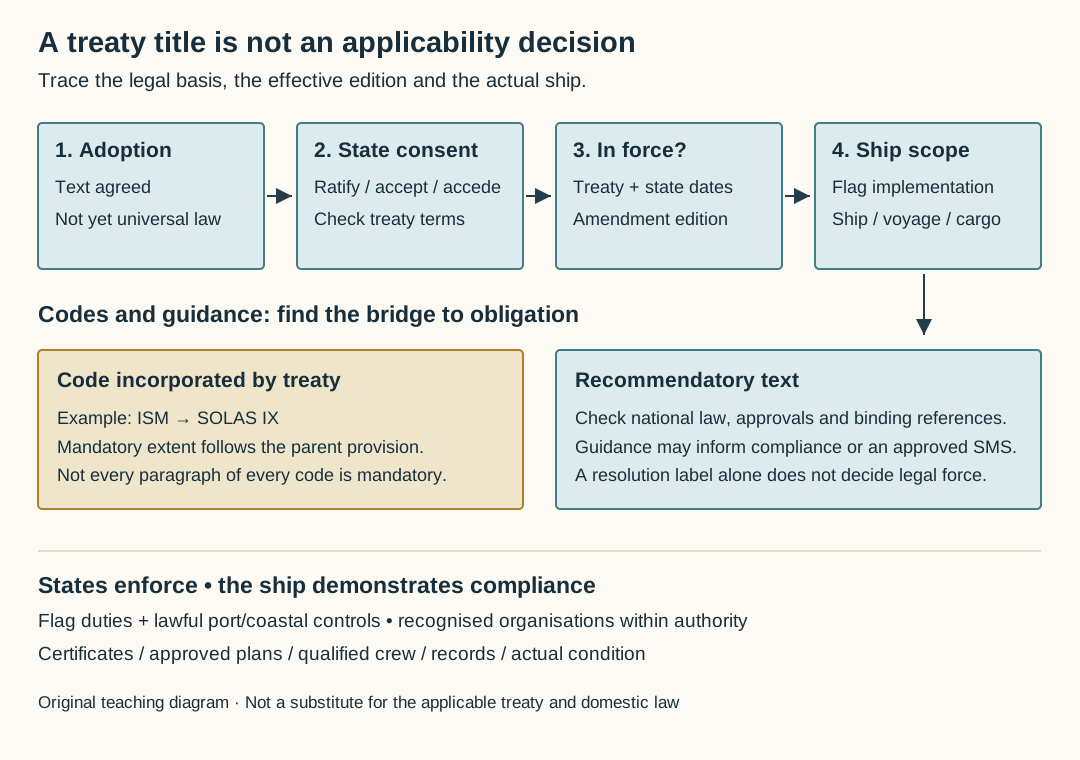
Original teaching diagram. It shows separate checks, not a universal chronological sequence: national implementation may be prepared before treaty entry into force, and consent and effective dates vary by State.
Adoption, ratification, accession and entry into force
Adoption agrees the text. Signature has the effect specified by the instrument; signature subject to ratification is not the same as definitive consent, though it may engage the duty not to defeat the treaty's object and purpose pending the State's decision.
Ratification, acceptance, approval and accession are ways of expressing consent to be bound when the treaty allows them. Ratification normally follows signature subject to ratification. Accession generally allows a State to become bound without that earlier signature. Accession is not restricted to the period after a treaty enters into force—the source's A24 answer is too categorical. Deposit with the designated depositary and the treaty's own provisions control the international action; domestic constitutional approval and implementation are separate questions.
Entry into force depends on that instrument's clause: required number of States, sometimes fleet tonnage or cargo criteria, and any waiting period. There is no universal “12 months / 15 States / 65%” test. Distinguish global entry into force, entry into force for a later-joining State and the applicable dates of individual amendments.
Explicit acceptance requires the affirmative acceptances specified for the amendment. Tacit acceptance uses a defined objection period/threshold, followed by the specified effective date. Not every amendment uses tacit acceptance; an adopted amendment is not necessarily already enforceable on this ship.
Reservations and interpretations are not a free opt-out
The source's A25 suggests any party may simply declare it will not be bound by part of an instrument. That is unsafe as a general legal statement. Under Vienna Convention Article 19, reservations are restricted where the treaty prohibits them, permits only specified reservations, or the proposed reservation is incompatible with its object and purpose. The particular maritime instrument, the depositary record and applicable rules on objections/effects must be checked. A document called a “declaration” cannot bypass these limits merely by its name.
Unified interpretations help consistent application, but are not automatically treaty amendments or a permission to ignore the text. Identify the issuing body, revision, applicable instrument and acceptance by the relevant administration. Distinguish an IMO interpretation from an IACS interpretation or a maker's technical explanation.
Important updates to the historical study answers
| Historical topic | Corrected reading as at 7 November 2026 |
|---|---|
| BWM Convention described as not in force | The convention entered into force 8 September 2017. Ship-specific management, survey and compliance requirements still require the applicable provisions |
| Hong Kong ship recycling convention described as not in force | Entered into force 26 June 2025; application and obligations depend on the relevant parties and provisions |
| 2010 HNS regime listed without a current date | IMO's official HNS page now lists entry into force 29 November 2027. That is a future date, not a convention already in force on this lesson's review date; use the latest depositary status for applicability |
| Rotterdam Rules treated as the replacement cargo regime | The reviewed UNCITRAL status page says not yet in force. Adoption in 2008 did not automatically replace Hague/Hague-Visby or Hamburg regimes |
| STCW Manila implementation discussed as future | The amendments entered into force 1 January 2012; the main transition ended 1 January 2017. Check subsequent amendments rather than stop at Manila |
| GMDSS A3 defined only by Inmarsat geostationary coverage | The modernised framework effective 1 January 2024 uses a recognised mobile satellite service. A3 depends on the service supported by the ship's installed earth station and continuous alerting coverage, excluding A1/A2 |
| MLC study stops at the 2014 amendments | The 2022 amendments entered into force 23 December 2024. ILO lists the approved 2025 amendments with expected entry into force 23 December 2027; do not treat that future edition as already effective |
| IHR 2005 discussed without later amendment status | WHO reports the 2024 amendments generally entered into force 19 September 2025, subject to rejection and State-specific positions. Check the applicable text for the relevant State |
| York-Antwerp Rules limited to older editions | CMI also publishes York-Antwerp Rules 2016. The incorporated contractual edition and governing law matter; no newest edition applies automatically |
This is a correction table, not a complete live register of parties, reservations, all amendments, ECAs or PSSAs. Consult the current depositary and consolidated instrument before a compliance decision. The historical UK statutory-instrument and M-notice references must likewise be checked for amendment, replacement and current scope; they are not presented here as current UK instructions.
SOLAS, MARPOL, Load Lines and COLREG applicability
SOLAS: do not apply one tonnage/voyage rule to the entire convention. Chapter I's general scope and exceptions do not settle every other chapter; Chapter V has broader navigation applicability subject to its provisions, and Chapter IV's cargo-ship radio threshold differs from the general cargo-ship threshold. The source's old chapter list is not a current consolidated index: later provisions include Chapter XV and the Industrial Personnel Code; see the dedicated IP Code lesson. Check ship type, voyage, build date, size, cargo, operating area and the actual regulation.
MARPOL: remember the six annex subjects: I oil; II noxious liquid substances in bulk; III harmful substances in packaged form; IV sewage; V garbage; VI air pollution. Application of discharge/operating rules is not the same as the threshold for a survey or certificate. Being below a particular certificate tonnage is not permission to pollute. Check party status and the applicable annex/protocol, special-area/ECA provisions, implementation and exemptions.
A MARPOL special area, a PSSA and an ECA are different legal concepts. Special-area protection is annex-specific; the pollution is not always oil. A PSSA has IMO-recognised sensitivity and associated protective measures; it does not itself establish one universal discharge prohibition. An ECA applies its designated emission controls under Annex VI, with effective dates and engine/ship criteria as relevant. Do not rely on the uploaded 2015 lists or assume designation and operational application began on the same date.
Load Lines: do not merge length and tonnage exceptions into one generic size rule. Read the applicable convention/protocol definitions of new/existing ship, Article 5 exclusions, voyage and geographical provisions, and national extensions. An exception means the specific provision's scope excludes the ship; an exemption is a permitted dispensation under conditions for an otherwise applicable requirement. Neither can be invented by the operator. Equivalent arrangements likewise require the applicable legal basis and authorised acceptance.
COLREG Rule 1: applies to all vessels upon the high seas and in waters connected therewith navigable by seagoing vessels, with its provisions on special rules. Do not limit lookout or collision-avoidance duties to ships whose flags appear on a treaty-membership list. Read local rules and the actual jurisdiction without treating IMO membership as a navigation exemption.
Mandatory codes and ship-specific evidence
Examples include ISM under SOLAS IX, the mandatory extent of ISPS under SOLAS XI-2, and IMDG, IBC and IGC under their applicable parent provisions. Do not say every part of the ISPS Code has identical mandatory status: Part A and the guidance in Part B must be read with the convention and any national incorporation. Likewise, STCW Code Part A contains mandatory standards and Part B recommended guidance.
The source's gas/chemical-carrier build-date categories are orientation only. Determine the accepted IGC/GC/existing gas code or IBC/BCH basis from construction/conversion definitions, applicable amendments, flag acceptance and the actual Certificate of Fitness. Do not use a remembered year to approve a cargo: the certificate's product list, conditions and approved systems matter. The old BC Code was replaced by the IMSBC Code; dangerous packaged cargo and solid bulk cargo are not interchangeable regimes.
Formal safety assessment is a regulatory decision-support method: hazard identification, risk assessment, risk-control options, cost-benefit assessment and recommendations for decision-making. It is not a ship certificate or substitute for an operation-specific risk assessment. Use current IMO guidance rather than assume the uploaded early circular is the latest edition.
MLC, UNCLOS and the other instruments on the Master's desk
The MLC 2006 is an ILO, not IMO, convention. Its five titles cover minimum requirements to work on a ship; employment conditions; accommodation/food/catering; health/medical care/welfare/social security; and compliance/enforcement. Its Articles and Regulations set the core framework; Code Part A is mandatory, while Part B is non-mandatory guidance that Members must give due consideration to. Substantial equivalence is available only within the convention's conditions, not a blanket opt-out. Certification scope differs from the broader substantive application; no MLC certificate does not necessarily mean no MLC rights.
For legacy ILO conventions, consult MLC Article X and each instrument's effect: ratification may cause automatic denunciation of revised conventions for that Member under the applicable terms. The MLC did not instantly revoke every older maritime labour convention worldwide. Flag inspection, port controls, labour-supplying responsibilities and on-board/onshore complaint arrangements have different roles.
UNCLOS provides the framework for territorial sea, contiguous zone, EEZ, continental shelf, navigation and flag duties. An EEZ is not territorial sea and does not confer the same general sovereignty. Dispute settlement depends on jurisdiction, choices and exceptions; not every dispute can simply be sent to ITLOS or the ICJ without checking consent and the applicable procedure. Continue with coastal-state jurisdiction.
Other distinct regimes include the Athens Convention for passenger/luggage liability, Nairobi Wreck Removal Convention for hazardous wrecks within its applicable area and extensions, ITU Radio Regulations, WHO IHR, cargo-liability conventions and York-Antwerp general-average rules. Liability, insurance and operational safety obligations are not interchangeable. CMI does not act as the treaty depositary or global enforcement authority for the Hague/Hague-Visby conventions simply because it works on maritime-law harmonisation.
A practical applicability check
Before relying on a study answer, record:
- The exact instrument, protocol, annex, code part and regulation.
- The applicable consolidated edition and amendment dates—not merely the publication year of a book.
- The relevant State's party status, effective date and lawful reservations/declarations.
- Domestic implementation, flag instructions and any applicable port/coastal requirements.
- Ship type, dimensions/tonnage, construction/conversion date, voyage, cargo and operating area.
- Required certificates, approved plans, crew competence, records and actual condition; any authorised exemption/equivalence and its conditions.
For example, a small ship without a particular pollution certificate still needs its applicable pollution rules checked. A flag joining one treaty has not necessarily joined all its protocols. A signed future convention does not automatically replace the existing cargo contract regime. When evidence conflicts, obtain the authorised interpretation rather than choose the easiest historical answer.
Self-test — 12 Questions
- Does IMO membership make a State party to every IMO convention?
Answer 1
No. Check each convention, protocol and relevant annex, its depositary record and effective date. Organisation membership and treaty participation are separate.
- Does adoption alone make a convention enforceable on every ship?
Answer 2
No. State consent, entry into force, applicable amendments, domestic implementation and the ship's scope must be established separately.
- Can accession occur before a convention enters into force?
Answer 3
Yes, where the treaty permits it. Accession expresses consent without necessarily requiring earlier signature; entry into force is determined separately by the treaty's clause.
- Can a party ignore any clause simply by filing a declaration?
Answer 4
No. Reservations and their effects are constrained by the treaty and applicable law, including Vienna Convention Article 19's restrictions. A declaration's name does not create a free opt-out.
- Does the word code or resolution determine whether every paragraph is mandatory?
Answer 5
No. Trace the parent treaty provision, incorporation mechanism, code part and applicable national rules. Some codes contain mandatory standards and recommendatory guidance.
- Who enforces applicable ship obligations rather than IMO inspectors?
Answer 6
Primarily the flag administration for its ships, with authorised delegated work and lawful port/coastal controls under the relevant regime. IMO develops instruments, not a worldwide ship-inspection service.
- Are BWM and Hong Kong recycling still awaiting their original entry into force?
Answer 7
No. BWM entered into force on 8 September 2017 and Hong Kong on 26 June 2025. Ship-specific obligations still require the applicable provisions and State position.
- Does the HNS page's 29 November 2027 date mean the regime is already in force on 7 November 2026?
Answer 8
No. It is a future entry-into-force date. Verify current official status and the relevant State's position before deciding applicability.
- Does being below a certificate threshold exempt a ship from all pollution rules?
Answer 9
No. Survey/certification thresholds and substantive operating or discharge requirements are different. Check the actual annex, regulation and ship scope.
- Are GMDSS A3 and its satellite service still defined as Inmarsat-only?
Answer 10
No. The modernised framework uses a recognised mobile satellite service; assess the coverage supported by the ship's earth station and applicable continuous alerting provisions, excluding A1/A2.
- Are STCW and MLC Code Parts A and B identical in legal status?
Answer 11
No. Part A contains mandatory standards; Part B is guidance. MLC Members must give due consideration to Part B, and any additional national incorporation must be checked.
- Are York-Antwerp Rules an IMO treaty that always applies in its newest edition?
Answer 12
No. They are CMI general-average rules, normally incorporated contractually. Check the agreed edition and governing law; a newer publication does not automatically replace the contract's edition.
Official sources and further reading
- Historical supplied outline: Section A, Maritime treaty instruments, A1–A140, 14 pages; footer The Shipmaster’s Business Self-Examiner. Author/edition not established; 2015–2016 references are historical. Extract not redistributed.
- IMO FAQ and organisation information and Status of Conventions: membership, structure and depositary status; review dates matter.
- UN Treaty Handbook and Vienna Convention on the Law of Treaties: consent, entry into force and Article 19 reservations.
- IMO BWM Convention, Hong Kong entry into force and HNS official page.
- IMO SOLAS, MARPOL, Load Lines, COLREG and STCW: overview does not replace consolidated text.
- IMO modernised GMDSS guidance MSC.1/Circ.1656.
- ILO MLC text and amendment history: mandatory standards, guidance, scope and amendment dates.
- UN UNCLOS text, UNCITRAL Rotterdam Rules status, ITU Radio Regulations and WHO IHR amendment announcement.
- CMI York-Antwerp Rules: editions and general-average guidance.