Every oil and gas field — onshore or offshore — passes through the same six-stage life cycle, from securing the right to explore to returning the site to nature. For the seafarer, each stage brings a different fleet to the field: seismic vessels, drillships, construction and DP vessels, supply boats, FPSOs, shuttle tankers and, at the end, heavy-lift and decommissioning crews.
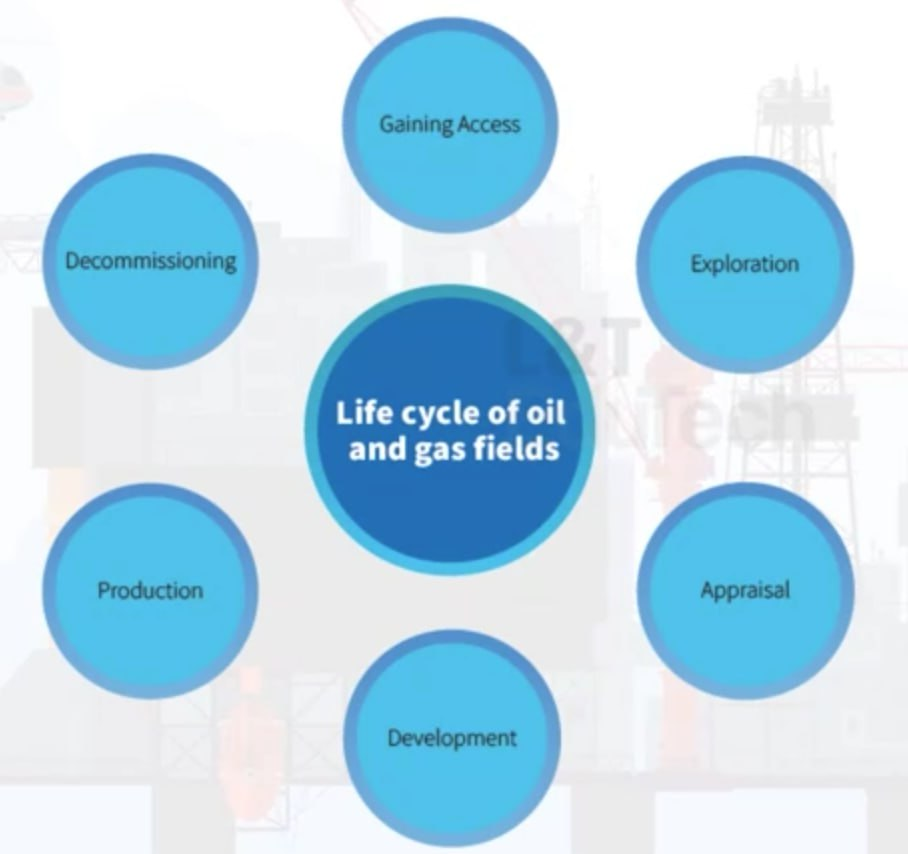
The life cycle of an oil and gas field — a continuous loop of six stages around the field itself.
1. Gaining Access
The operator obtains a licence, lease or production-sharing agreement from the host government, often through a licensing round. Environmental baseline studies and stakeholder consultation begin here.
At sea: environmental survey and metocean data collection.
2. Exploration
Geologists and geophysicists search for traps that may hold hydrocarbons. Seismic surveys image the subsurface; promising prospects are tested with an exploration ("wildcat") well.
At sea: 2D/3D seismic vessels towing streamers, jack-ups, semi-submersibles and drillships.
3. Appraisal
After a discovery, appraisal wells and well tests establish the size of the reservoir, fluid properties and flow rates — enough to decide whether the field is commercial.
At sea: drilling units, well-test vessels, supply and standby vessels.
4. Development
The field development plan is approved and the facilities are built: production wells, platforms or subsea templates, pipelines, risers and floating units.
At sea: DP construction vessels, pipelay and heavy-lift vessels, diving support vessels, anchor-handling tugs.
5. Production
The longest stage — often 20 to 40 years. Hydrocarbons are produced, processed and exported. Output rises to a plateau, then declines; enhanced recovery techniques may extend field life.
At sea: platforms and FPSOs, shuttle tankers, platform supply vessels, crew boats, ROV and IMR vessels.
6. Decommissioning
When production is no longer economic, wells are plugged and abandoned, and facilities are removed or made safe in line with regulations such as the IMO 1989 Guidelines and OSPAR Decision 98/3 in the North-East Atlantic. The site is surveyed and restored.
At sea: heavy-lift and single-lift vessels, well-intervention vessels, cutting and debris-clearance spreads.
Summary table
| Stage | Key question | Typical vessels |
|---|---|---|
| Gaining Access | May we explore here? | Survey vessels |
| Exploration | Is there oil or gas? | Seismic vessels, drilling units |
| Appraisal | Is it worth developing? | Drilling units, well-test vessels |
| Development | How do we produce it? | Construction, pipelay, heavy-lift, DSVs |
| Production | How do we maximise recovery? | FPSOs, PSVs, shuttle tankers |
| Decommissioning | How do we leave it safely? | Heavy-lift, P&A vessels |
Who produces the world's oil?
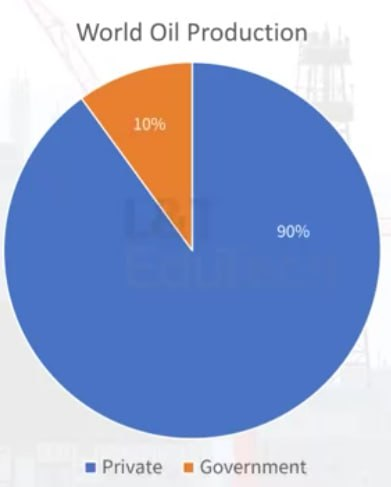
Chart as supplied: private 90%, government 10%.
Every field in the life cycle has an owner. That owner is either an international oil company (IOC), which is privately or publicly listed, such as ExxonMobil, Shell, BP, Chevron or TotalEnergies, or a national oil company (NOC) owned by the state, such as Saudi Aramco, ADNOC, NIOC, Petrobras or Equinor.
Reading note: Most industry sources describe the opposite balance to this chart. National oil companies control roughly 90% of proven reserves and about half or more of world production. The privately owned majors hold only around 10% of reserves. Treat the chart's figures as a discussion point and check them against current IEA or EIA data.
Why it matters at sea: NOC fields often bring local-content rules, state-owned charterers and national flag preferences for offshore and tanker fleets. IOC fields tend to run on global contractor chains and IMCA/OCIMF-based vetting.
Master's note
Knowing which stage a field is in tells you what operations to expect around it: simultaneous operations (SIMOPS) peak during development, while production brings routine supply runs and 500-metre safety-zone procedures.
Related: S.H. Griffin #4 and the shale revolution · Dynamic Positioning fundamentals
Offshore structures: compliant towers and risers
Compliant towers
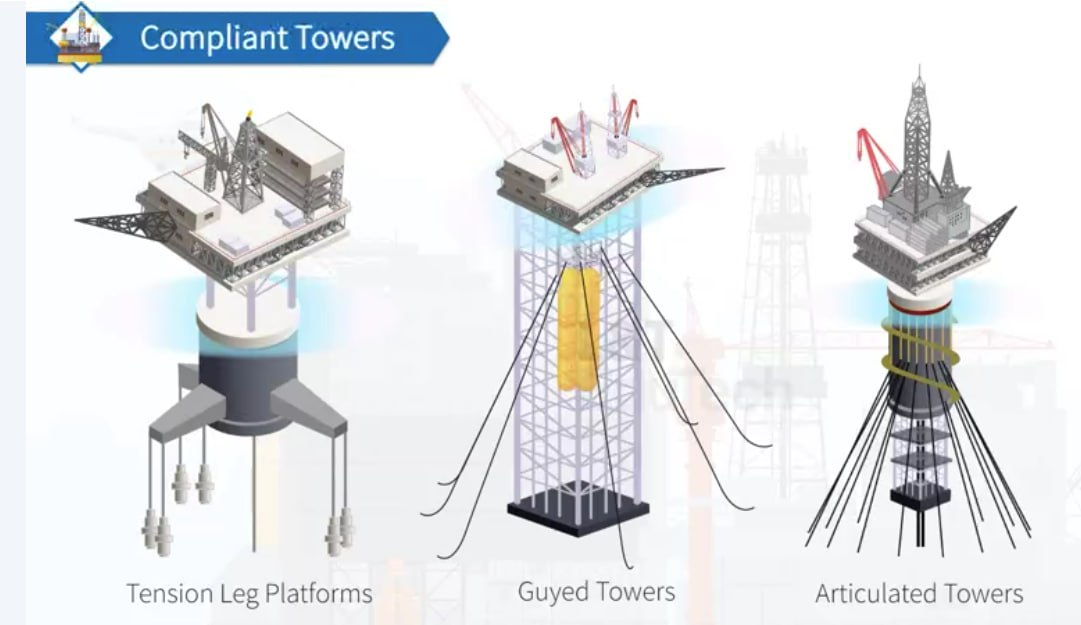
Compliant structures flex with wind, wave and current instead of resisting them rigidly.
In deeper water a fixed steel jacket becomes too heavy and too stiff. Compliant structures are designed to move a little with the sea, like a reed in a current, so the loads they carry stay manageable.
| Type | How it stays on station | Key point for the seafarer |
|---|---|---|
| Tension Leg Platform (TLP) | Buoyant hull pulled down by vertical steel tendons anchored to seabed piles | Almost no heave; sideways offset is small but real |
| Guyed Tower | Slender lattice tower on the seabed, held upright by guy (mooring) lines fanned out to clump weights or anchors | Mooring lines spread wide on the seabed — mind them when anchoring or working ROVs |
| Articulated Tower | Tower sits on a universal joint at the seabed; buoyancy tanks keep it upright and it sways around the pivot | Often used as a loading point; tankers moor to it and weathervane |
Risers
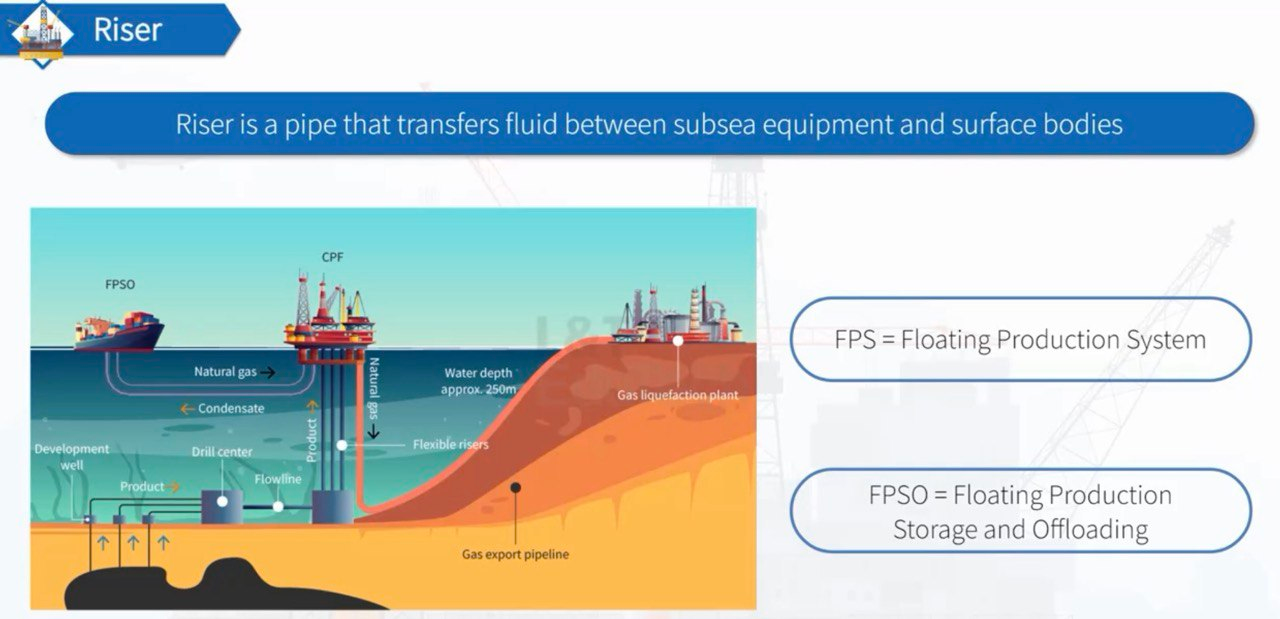
A riser is a pipe that transfers fluid between subsea equipment and the surface.
Wells on the seabed send product along flowlines to a drill centre. From there risers carry it up to the surface facility — a fixed central processing facility (CPF), a Floating Production System (FPS) or an FPSO (Floating Production, Storage and Offloading) vessel. Gas can then go ashore through an export pipeline, for example to an LNG plant, while condensate is stored and offloaded to shuttle tankers.
- Rigid risers suit fixed platforms and steady structures.
- Flexible risers follow the motion of floating units and are the usual choice for FPSOs.
- For a DP or anchor-handling vessel inside the field, risers and flowlines are the critical subsea hazard: keep to the approved field plan and exclusion zones.