Every machinery space produces bilge water — a sour mix of drainings, leaks, washings and condensate carrying free oil, dispersed droplets and emulsions. None of it may go overboard until the oil content is below the MARPOL Annex I limit of 15 ppm. Two pieces of equipment do most of that work aboard: the gravity plate separator and the centrifugal oily water separator. They use the same physical principle — oil is lighter than water — but they exploit it in very different ways, and on many ships they work as consecutive stages of one treatment train.
Why separation works at all
Oil and water part company because of their density difference. Left undisturbed in a quiet tank, free oil rises and the water clears. But a ship is not a quiet tank: pumps shear oil into fine droplets, detergents emulsify it, and vibration keeps the mixture stirred. Separation equipment exists to restore what the machinery space destroys — calm coalescence, or an artificial gravity thousands of times stronger than the one nature provides.
The gravity plate separator
A gravity plate separator treats bilge water by combining the natural density difference between oil and water with oleophilic (oil-attracting) plates.
How it works
- Flow through oleophilic plates — Contaminated bilge water enters the separator and flows through a series of closely spaced inclined plates. The plates attract oil, causing fine droplets in the water to adhere to their surfaces.
- Coalescence of oil droplets — As droplets accumulate on the underside of the plates, they combine into larger ones. These become buoyant enough to detach and rise to the surface of the chamber.
- Separation by density — Being less dense than water, the oil collects as a surface layer, while the treated water exits from the bottom.
- Oil removal — The accumulated oil at the top of the chamber is periodically drawn off to a sludge tank for proper disposal or recycling ashore.
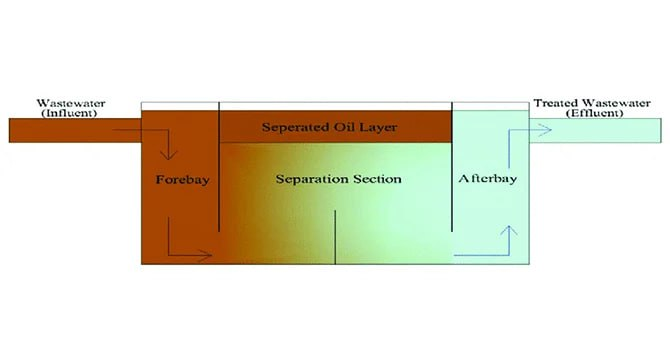
In the classic layout the flow passes through a forebay (where the incoming water is distributed and slows down), the separation section with its plate pack, and an afterbay from which the cleaned effluent leaves — exactly the arrangement shown in the diagram above.
Strengths and limits
| Advantages | Limitations |
|---|---|
| Simple, reliable design with minimal maintenance | Ineffective against emulsified or dissolved oils |
| Oleophilic plates boost coalescence and efficiency | Sensitive to flow rate — high flow disturbs settling |
| No moving parts in the separation zone | Plates need regular cleaning to stay oleophilic and avoid clogging |
The centrifugal oily water separator
Where plates rely on patience, the centrifugal separator relies on force. It separates oil from bilge water using centrifugal force generated inside a rotating chamber.
How it works
- Rotating container — Oily bilge water is introduced into a cylindrical, rotating bowl or chamber. The rotation generates a centrifugal field that separates substances by density.
- Oil and water separation — Water, being denser than oil, is forced outward toward the circumference of the bowl. Oil, being lighter, accumulates in the low-pressure core at the centre.
- Removal — The separated water is discharged overboard if it meets the standard (typically below 15 ppm oil content, verified by the monitor). The oil collected at the centre is drawn off and stored for proper disposal or recycling.
The artificial gravity inside a spinning bowl reaches thousands of g — force no plate stack can match. That is why centrifuges handle fine, dispersed droplets that would drift straight through a gravity plate unit.
Strengths
- Efficient separation — the strong centrifugal field is highly effective at splitting oil and water, including emulsified droplets.
- Compact design — a relatively small unit handles large volumes of bilge water in a short time.
- Compliance — helps the ship meet MARPOL Annex I by ensuring effluent meets the discharge standard.
Where each is used
| Application | Gravity plate separator | Centrifugal separator |
|---|---|---|
| Ships — bilge water treatment | First-stage bulk removal | Polishing stage for fine droplets |
| Industrial facilities — oily wastewater | Wide use | Wide use |
| Oil refineries — process water | — | Common choice |
The treatment train in practice
On a well-run ship, the two methods rarely compete — they cooperate. Bilge water settles in the holding tank, passes a pre-strainer, surrenders its free oil in the plate stage, is polished in the centrifuge, and only then faces the 15 ppm oil content monitor. If the monitor is not satisfied, the discharge stops automatically and the water returns for another pass. Every transfer and discharge is entered in the Oil Record Book; recovered oil is landed ashore.
By using density differences — whether on a quiet plate or in a spinning bowl — these separators turn a marine pollutant into a manageable waste stream, protecting both the engine room's conscience and the marine environment.