Investigation boundary: This lesson summarises the UK Marine Accident Investigation Branch (MAIB) interim report published in April 2025. It separates reported facts from matters still under investigation. It does not determine liability, apportion blame or replace the final investigation report.
What the interim report establishes
At 0947 UTC on 10 March 2025, the Portugal-registered container ship Solong collided with the port side of the anchored, USA-registered oil/chemical tanker Stena Immaculate, 14 nautical miles north-east of Spurn Head at the entrance to the Humber Estuary.
Solong was on passage from Grangemouth to Rotterdam with 14 people aboard and mixed containerised cargo, including some dangerous goods. Stena Immaculate had 23 people aboard and was carrying 220,204.5 barrels (35,009.7 m³) of aviation fuel to Killingholme.
| Time (UTC) | Reported event |
|---|---|
| 9 March, about 1830 | Stena Immaculate anchored north of the Humber VTS area after ABP VTS Humber advised a position five miles north of the Humber light float and two miles clear of any pipeline. Eight other vessels were anchored in the same area. |
| 9 March, by 2000 | Solong departed Grangemouth, disembarked the pilot and started passage to Rotterdam on a route used previously. |
| Shortly before 2300 | Solong's master handed the watch to the second officer and retired. |
| Shortly before midnight | Stena Immaculate's second officer took over the anchor watch at the start of a 12-hour duty period. |
| 10 March, about 0130 | Solong passed Longstone Lighthouse and altered to a heading of approximately 150°. A slight deviation followed at 0345. |
| 0700 | Solong's master returned to the bridge and took over as the lone watchkeeper. |
| 0947 | Solong struck Stena Immaculate's port side on heading 150° at about 16 knots speed over ground. |
The report describes visibility north of the Humber light float as patchy and varying between 0.25 and 2.0 nautical miles. It also states that neither vessel had a dedicated lookout on the bridge.
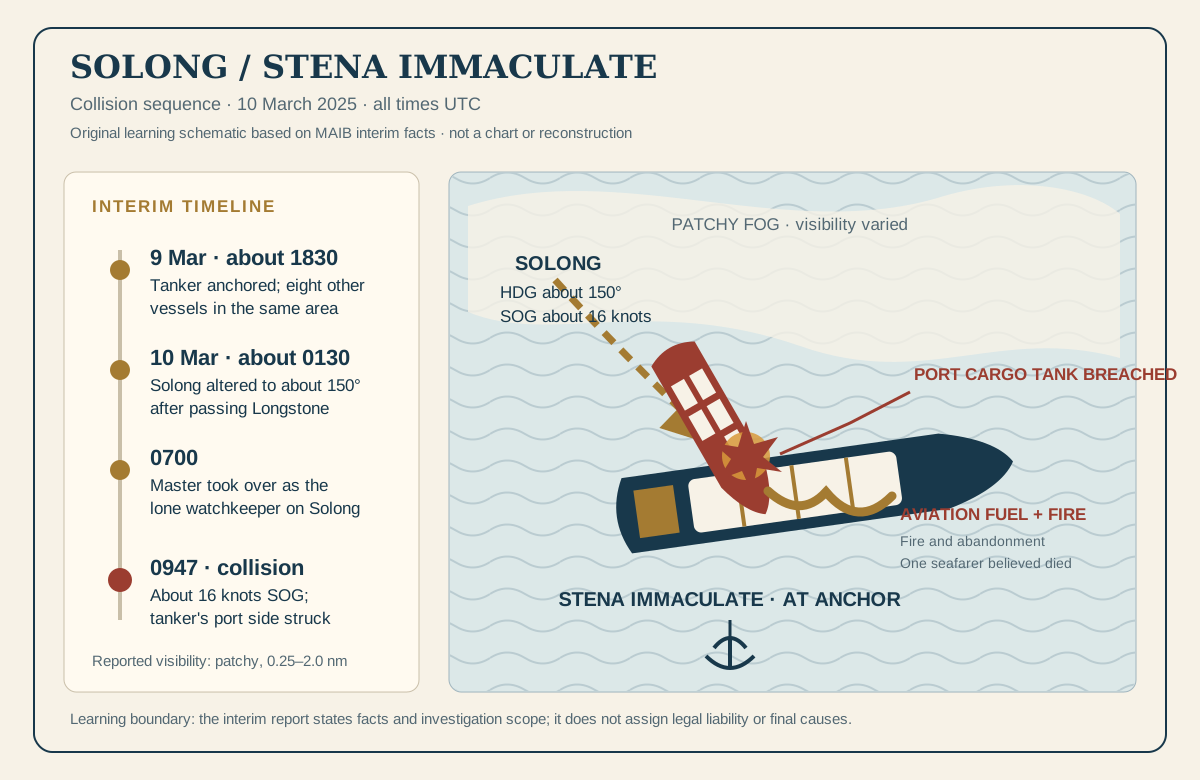
Original learning schematic based on the interim report's factual information. It is not a chart, a scale reconstruction or evidence of the vessels' precise relative geometry before impact.
From impact to fire and abandonment
The collision breached Stena Immaculate's No. 7 port cargo tank. Aviation fuel was released into the sea and onto Solong's bow. According to the interim report, heat generated by the force of the collision ignited the fuel, and the resulting fire ignited contents of containers aboard Solong.
Both crews took immediate action. The severity of the fire hampered Stena Immaculate's firefighting and Solong's attempts to locate missing able seaman Mark Pernia, who had been reported in the forecastle area. Both crews abandoned to lifeboats and were recovered through the efforts of local boats and emergency responders coordinated by HM Coastguard. Mark Pernia was not found and was believed to have died.
At the interim stage, both vessels were undergoing salvage operations and the nature and extent of pollution was still being evaluated.
What the interim report does not decide
An interim report is not a final causal analysis. MAIB said the investigation would encompass:
- navigation and watchkeeping practices on both vessels;
- manning and fatigue management;
- the condition and maintenance of both vessels;
- use of the offshore area as an anchorage for ships waiting to enter the Humber Estuary; and
- environmental conditions at the time.
The official current-investigations page, updated 2 November 2026, still listed the interim report when this lesson was prepared. Do not convert the factual sequence into conclusions about blame, legal liability, fatigue, equipment condition or the adequacy of the anchorage before the investigation addresses them.
Watchkeeping learning points — not investigation findings
A dedicated lookout is only one part of the appraisal
COLREG Rule 5 requires a proper lookout by sight and hearing and by all available means appropriate to the prevailing circumstances, so the situation and risk of collision can be fully appraised. Radar, AIS and ECDIS can support that appraisal; none replaces sight, hearing or active interpretation.
The report's statement that there was no dedicated lookout is not, by itself, a final finding on every aspect of Rule 5 compliance. It is a reason to examine whether bridge manning, workload and lookout arrangements matched the visibility, traffic and anchored-vessel risk.
Safe speed is not a fixed number
The reported 16 knots is a fact, not a universal judgement that a particular speed is safe or unsafe elsewhere. Rule 6 requires speed appropriate to the circumstances. Visibility, traffic density, manoeuvrability, background lights, wind, sea, current and available radar information all matter. In restricted visibility, Rule 19 also requires the conduct appropriate to those conditions.
Ask not only “what is the speed?” but “what detection time, decision time and stopping or turning room does this speed leave in these conditions?”
A familiar route still needs appraisal
A route used before does not make its present traffic picture predictable. Passage appraisal should identify likely anchorages, waiting areas, approaches and reporting points. Monitoring should test the actual track against the present charted picture, radar targets, visual information and changing visibility—not merely confirm that the ship is following a familiar magenta line.
Anchor watch remains an active watch
A vessel at anchor must maintain the watch and signals required by the applicable rules and vessel procedures. Position monitoring, weather and visibility checks, traffic appraisal, readiness and timely escalation remain important. The presence of other anchored ships does not remove the need to assess each approaching target. Equally, this general duty is not a conclusion about what either crew did or could have achieved in this casualty.
Emergency-response lessons without hindsight
The reported sequence shows how quickly a navigational casualty can become a hazardous-cargo fire, a missing-person search, an abandonment and a pollution response at the same time.
- Life safety comes first. Muster, accountability and communication must continue while the master assesses firefighting, search and abandonment.
- A search is not an uncontrolled entry. Fire, smoke, structural damage and cargo hazards can make an attempted rescue another casualty. Follow the ship's emergency organisation and risk assessment.
- Dangerous goods change the problem. Identify cargo information and communicate it to responders, but do not assume every container behaves alike or that a generic firefighting method is suitable.
- Prepare for concurrent emergencies. Bridge, engine room, fire parties, lifeboat crews and shore responders need clear priorities and closed-loop communication.
The interim report says the severity of the fire hampered both firefighting and the search. It does not support a simplistic claim that more aggressive action would necessarily have saved the missing seafarer.
Bridge-team discussion
Use the facts without inventing missing evidence:
- What additional appraisal would you want before passing a group of anchored vessels in patchy visibility?
- What information would trigger a reduction in speed, an alteration, additional bridge support or a call to the master on your vessel?
- How would you distinguish a tracked target's reported data from your own appraisal of its risk?
- At what point do fire, missing-person and cargo hazards require priorities to change? Who has that authority under your vessel's procedures?
Record the discussion as professional learning, not as a verdict on the crews involved.
Self-test
- What collision facts does the interim report state for 0947 UTC on 10 March 2025?
Answer 1
Solong struck the anchored Stena Immaculate's port side 14 nautical miles north-east of Spurn Head. Solong was on heading 150° at about 16 knots speed over ground. The tanker's No. 7 port cargo tank was breached.
- Does “no dedicated lookout” prove that nobody on either bridge performed any lookout function?
Answer 2
No. The phrase records the absence of a dedicated lookout; it is not a complete description of every lookout activity or a final legal conclusion. Rule 5 still requires a proper lookout by sight, hearing and all available appropriate means.
- Does the reported speed of about 16 knots establish a universal safe-speed limit for restricted visibility?
Answer 3
No. Safe speed depends on the prevailing circumstances, including visibility, traffic, manoeuvrability, environmental conditions and the time available to detect, assess and act. The interim report records the speed; it does not create a numerical rule.
- Why is a previously used route not sufficient evidence that the present passage is safe?
Answer 4
Traffic, anchored vessels, visibility, weather and other conditions change. The route must be appraised and monitored against the present charted and observed situation, including anchorages and port-approach waiting areas.
- Name three subjects MAIB said its investigation would examine beyond the immediate collision sequence.
Answer 5
Any three of: navigation and watchkeeping practices; manning and fatigue management; vessel condition and maintenance; use of the offshore anchorage; and environmental conditions. These are investigation topics, not established causes.
- How did the collision develop into a fire aboard both ships?
Answer 6
The tanker's No. 7 port cargo tank was breached, releasing aviation fuel into the sea and onto Solong's bow. The interim report says heat generated by the collision ignited the fuel, and the resulting fire ignited contents of Solong's containers.
- What limitation did the fire place on the crews' immediate response?
Answer 7
Its severity hampered Stena Immaculate's firefighting and Solong's attempts to locate the missing able seaman. Both crews subsequently abandoned to lifeboats and were recovered by local boats and emergency responders coordinated by HM Coastguard.
- How should an officer use this interim report in training without overstating it?
Answer 8
Use its dated factual sequence to discuss lookout, safe speed, route appraisal, anchor watch and emergency priorities. Label those as learning questions. Do not present final causes, blame, liability or vessel-specific conclusions that the interim report has not established.
Sources and further reading
- UK MAIB: Solong and Stena Immaculate interim report published, 3 April 2025
- UK MAIB: official interim report PDF
- UK MAIB: current investigations and report status
- IMO: COLREG — preventing collisions at sea
- Companion lessons: Duties of the Officer of the Watch, Fundamentals of the Rules of the Road, Passage Planning: The Four Stages, SOLAS Fire Safety, and Master's P&I Handbook: First Actions in Claims and Emergencies.
Source reviewed: four-page MAIB interim report, April 2025. The uploaded document is not redistributed by this lesson; the links above lead to MAIB's official public copies. This is professional education, not a legal opinion or a substitute for the final report, COLREGs, the SMS or the master's orders.