Source, edition and limits
This original lesson uses the supplied DNV-OS-E402, Diving systems, edition July 2024, issued by DNV AS, with the official IMO source linked below. The document has 103 pages: the first 50 were parsed, and later technical and certification sections were reviewed through local text extraction. This is a focused teaching companion, not an exhaustive compliance review. The restricted PDF, page images and original figures are not redistributed.
The July 2024 edition superseded DNVGL-OS-E402 July 2019 and reorganised the standard to align with the 2023 Diving Code. This lesson was reviewed 7 November 2026; July 2024 is the source edition, not a claim that it is the latest or applicable edition for every installation. Establish the governing class, flag and coastal-state requirements using authorised rules and the actual installation documents.
Safety boundary: this is not a dive plan, decompression schedule, gas-mixing recipe, pressure-test instruction or permission to modify equipment. Diving operations require competent personnel, approved procedures, the diving supervisor’s control and the applicable medical/emergency arrangements. Never improvise pressure release, oxygen-service cleaning, gas substitutions or rescue entry from a study lesson.
What the standard covers—and what it does not
Ch.1 Sec.1 [3–4] addresses surface-orientated and saturation diving systems, fixed or portable: design philosophy, system requirements, diving components, and classification/certification. It is complementary to the IMO 2023 Diving Code.
| System | Teaching distinction | Main assurance question |
|---|---|---|
| Surface-orientated | Divers work from the surface using the configured supply, recovery and chamber arrangements; wet-bells or baskets may be used | Can the divers be supported and recovered, and any required decompression/treatment completed, after a credible failure? |
| Saturation | Divers live under pressure between excursions, typically transferring through a closed bell | Can the occupied pressure environment and life support be maintained through failure, recovery and evacuation? |
| Portable installation | Equipment is mobilised onto a vessel or unit | Has the actual installation—including supports, services and interfaces—been accepted and tested? |
A wet-bell is not a closed saturation bell. Do not transfer requirements between configurations without checking their applicability.
The support vessel’s flotation and positioning ability are outside E402’s scope and are addressed separately in DNV-RU-SHIP Pt.5 Ch.10. A diving-system certificate does not establish DP capability, a safe working position or safe thruster/umbilical separation. Hospital hyperbaric oxygen therapy facilities are not covered by this standard.
Read the system as a chain of safety barriers
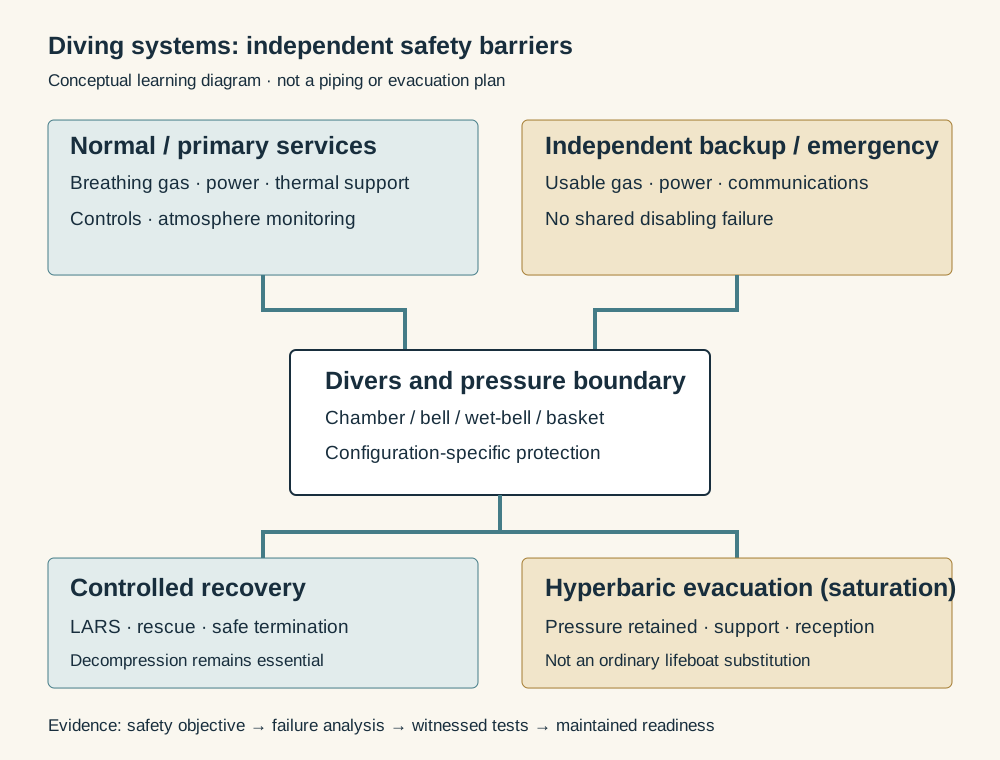
Original teaching diagram: connections show safety relationships, not actual pipework, redundancy groups or a rescue sequence. The primary/secondary/emergency terminology and arrangements depend on the diving configuration.
Under Ch.2 Sec.1 [2.1, 2.5–2.6], a single component failure or inadvertent act should not create a life-threatening situation. Where duplication is not practicable, suitable independent backup or recognised manned-service design standards and safety factors are needed. “Two pumps” or “two cylinders” is not proof of independence: examine shared power, manifolds, valves, controls, contamination paths and physical exposure.
Start with the safety objective and redundancy specification: what each service must deliver, how long it is needed, what fails, when backup becomes usable and what state the system reaches. An FMEA must demonstrate that objective, not merely list existing equipment. Repair-based mitigation must be assessed against the assumed response time. Hidden failures, special procedures, spares and drills must be carried into planned maintenance and survey arrangements. Verification requires an approved failure-test programme, not paperwork alone.
Gas supply: identity, usable capacity and independence
Ch.2 Sec.2 [1.1–1.9] distinguishes primary, secondary and emergency gas arrangements for surface systems, and segregated normal/emergency storage for saturation systems. Capacity is configuration-specific: planned depth, personnel, ventilation, recovery, decompression and possible treatment affect the assessment.
Check evidence for gas identity and quality, correctly identified cylinders and lines, accessible reserves, delivery at the required pressure/flow, independent standby-diver arrangements and safe changeover. A bank’s nominal cylinder volume or gauge pressure alone does not prove usable emergency capacity. Contaminated compressor intake is a shared hazard even when more than one compressor is fitted.
An important edition-specific distinction: Ch.2 Sec.2 [1.8.2] specifies a 30-minute independent self-contained emergency supply from the basket or wet-bell, in addition to normal umbilical supply. [1.8.3] adds wet-bell gas capacity for the divers’ in-water stops. Elsewhere, Ch.2 Sec.1 [2.3–2.4] uses 20-minute minimum service-support assumptions for certain recovery situations. These are different requirements, not interchangeable universal bailout times. Actual approved capacities and the dive plan must account for the complete credible emergency; no reader should size a system from this paragraph.
Life support is more than oxygen
Ch.2 Sec.2 [2] and Sec.3 [7] address the environment that keeps divers alive: oxygen partial pressure, carbon dioxide removal, thermal conditions, humidity and contaminants. Pressure containment and controlled pressure changes remain fundamental.
An oxygen percentage without ambient pressure does not establish the oxygen exposure. Normal oxygen readings do not exclude dangerous CO₂, contaminated gas or loss of heat. Verify calibration, suitable hyperbaric instrumentation, alarm response and available manual backup. Automatic control and independent alarm arrangements must not share a failure that defeats both; see Ch.2 Sec.3 [7.8].
Oxygen-service compatibility, cleanliness, materials and ignition risks need specialist controls under Ch.2 Sec.3 [4.4]. Ordinary lubrication, unapproved replacement parts or apparently harmless contamination can be unacceptable. This lesson supplies no universal oxygen setpoint, cleaning method or treatment table.
Launch and recovery: more than a lifting certificate
Ch.2 Sec.3 [5] treats the diving launch and recovery system (LARS) as an integrated manned system. The approved working weight includes the fully equipped bell/basket, divers and relevant equipment; dynamic vessel motion, hydrodynamic loads, start/stop effects and slack-wire jerks affect design loads.
A crane’s static SWL is not permission to use it as diving LARS. Check the approved working configuration, operational sea-state, load path, winches/brakes, emergency arrangements, umbilical handling and safe disembarkation. [5.4.2] requires basket/wet-bell recovery to a location secured against falling independently of the lifting wires and against relative vessel motion, with the specified redundant/emergency or manual arrangements up to that point.
The chapter’s 2 m significant-wave-height boundary concerns a design-load calculation option, not a universal permission to dive below 2 m or a universal prohibition above it. Use the installation’s approved limits and operational risk assessment. The July 2024 changes also removed the old requirement that the guide-wire weight catch a falling bell/basket; never assume it is a certified fall-arrest system.
Hyperbaric evacuation: recovery does not end at launch
For saturation divers, reaching the deck does not mean they can immediately be brought to atmospheric pressure. Emergency abandonment must preserve the required pressure environment and life support.
Ch.2 Sec.3 [9] covers hyperbaric survival craft (HBSC), with certification under the 2023 Diving Code. [9.2] requires additional/emergency life-support arrangements, verified compatibility and contingency planning for a life-support package (LSP) to reach the craft. Support connections, communications, access and realistic response time matter. A compatible connector alone is not a complete evacuation plan.
Follow the approved hyperbaric evacuation/reception arrangements through to continued support and controlled decompression. An ordinary lifeboat is not a substitute. E402 Ch.2 Sec.1 [2.4.5] identifies services supporting hyperbaric evacuation as statutory scope reviewed under the applicable administration’s instructions: class and statutory evidence must be distinguished.
From certificates to installation readiness
Ch.3 Sec.1 sets documentation and certification requirements. System particulars, general arrangement, FMEA, integration test procedures, installation documentation, quay/sea trials and inspection/survey planning address different evidence layers.
| Evidence layer | What to establish |
|---|---|
| Components | Identity, applicable certification, pressure/lifting/electrical ratings and compatibility |
| Integrated system | Accepted configuration, safety objective, failure analysis and normal/emergency test results |
| Vessel installation | Supports, interconnecting services, interfaces, actual mobilisation and commissioning |
| Operational readiness | Maintained equipment, usable supplies, competent team, agreed limits and practised contingency arrangements |
A type-approved component does not approve the whole system; a previously accepted portable system is not automatically ready on a different vessel. Reassess changes in power supply, location, supports, connections, occupancy or operating envelope before use. A certificate does not replace the supervisor’s operational decision or the Master’s vessel-safety responsibilities.
Practical scenarios: recognise the missing barrier
- Both gas sources share a suspect intake: stop treating duplication as independence. Escalate under the approved contingency arrangements; resolve gas-quality and common-cause exposure before another dive.
- Backup power is unavailable: a healthy primary supply does not restore redundancy. The systematic review must identify failures that leave essential services non-redundant or remove emergency safeguards as requiring dive termination (Ch.2 Sec.1 [2.6.2]). With divers committed, termination means controlled recovery under the approved plan—not cutting services or rapidly depressurising chambers.
- A portable system is moved to another vessel: verify the new supports, services and interfaces, and required mobilisation tests. “Same equipment” is not “same approved installation.”
- An LSP cannot reach the HBSC in the assumed time: the contingency is not demonstrated. Address compatibility, location, transport and support/reception arrangements before reliance on it.
Self-test — 8 Questions
- Does E402 approval establish a support vessel’s DP capability?
Answer 1
No. E402 covers the diving system; support-vessel flotation and positioning are outside its scope and require separate applicable rules and operational assessment.
- Why might two gas sources fail the independence test?
Answer 2
They may share a contaminated intake, electrical supply, manifold, valve, control or physical hazard. Independence is established through the actual failure analysis and tested arrangement, not the equipment count.
- Can the 20-minute service provisions replace the July 2024 basket/wet-bell emergency-gas requirement?
Answer 3
No. E402 Ch.2 Sec.2 [1.8.2] specifies a 30-minute self-contained emergency supply from the basket/wet-bell, additional to normal supply; [1.8.3] adds gas for wet-bell in-water stops. The 20-minute service-support provisions address different requirements. Use the complete approved capacity assessment.
- Does a normal oxygen reading prove the chamber environment is safe?
Answer 4
No. Pressure, oxygen partial pressure, CO₂, contaminants and thermal conditions need suitable monitoring and life-support arrangements. Calibration, alarms and independent backup also matter.
- Does a crane’s SWL establish its suitability as diving LARS?
Answer 5
No. Manned recovery requires the approved integrated system, working weight, dynamic design loads, operating envelope, emergency arrangements and secured disembarkation. A static lifting rating alone is insufficient.
- Why is an ordinary lifeboat not a saturation-diver evacuation substitute?
Answer 6
Saturation divers require continued pressure containment and life support. The approved hyperbaric evacuation arrangement must include compatible support, contingency/reception arrangements and controlled decompression.
- What should follow discovery that an essential system has lost required redundancy?
Answer 7
Apply the approved failure/termination arrangements under the diving supervisor’s control. Recover and support committed divers safely; do not simply cut services, rapidly depressurise or continue because the primary equipment still runs.
- What additional evidence is needed when a portable system changes vessel?
Answer 8
Acceptance of the actual installation and interfaces, applicable mobilisation/commissioning tests, updated failure/contingency assessment and maintained operational readiness—not merely the old component certificates.
Sources and further reading
- Primary reviewed source: DNV AS, DNV-OS-E402, Diving systems, July 2024: Ch.1 Sec.1; Ch.2 Sec.1 [2], Sec.2 [1–5], Sec.3 [4.4, 5, 7–9]; Ch.3 Sec.1. Restricted uploaded copy not reproduced.
- DNV Rules and Standards Explorer and DNV rules and standards: establish authorised editions and related vessel/system requirements.
- IMO 2023 Diving Code, MSC.548(107): international diving-system safety framework; check the instrument’s application provisions and the relevant administration’s implementation rather than assuming universal statutory application.