The alert: useful case, not a universal rule
This original lesson reviews the supplied Safety Alert 06/2026, “XTD / XTL SETTING IN ECDIS”, dated 22 October 2026, Darwin, Australia, prepared by Sino Cosmos Ship Management Limited, HKG. The one-page company circular reports an AMSA port State control deficiency and a disputed comparison between coastal cross-track settings and the Master's CPA instruction. It is not an AMSA-issued safety notice. The underlying inspection record, appeal outcome and any flag-State interpretation have not been independently verified. The company PDF and poster are not redistributed.
The report gives a coastal XTD of 1,000 m and a CPA instruction of 1 NM (1,852 m). These are case-specific examples, not recommended settings. Its proposal to route-check at the ECDIS maximum XTD and then restore the SMS setting needs equipment-specific and navigational qualification. Neither matching XTD to CPA nor using the maximum selectable width proves a safe passage.
Safety boundary: awareness and passage-planning discussion, not an ECDIS operating procedure or authority to change the ship's SMS. Use the installed equipment manual, applicable performance standard, approved company procedures, chart information, Master's instructions and local requirements. No universal XTD, CPA, UKC or safety-contour value is supplied here.
Three quantities that must not be confused
| Quantity | What it describes | What it does not prove |
|---|---|---|
| Actual cross-track distance/error | The vessel's lateral displacement from the planned route leg; terminology and sign convention depend on the equipment | A safe separation from another ship |
| Cross-track limit (XTL), sometimes labelled XTD | Selected route-relative boundary, potentially separate port/starboard values, used for off-track monitoring and, on some systems, route-check corridor definition | All water inside the boundary is safe, or that all checks use this width |
| Closest point of approach (CPA) | Predicted minimum separation between own ship and a target, based on relative motion and the available tracking data | Required lateral departure from the planned route, or permission to enter shoal water |
TCPA is the predicted time to CPA. Treat CPA/TCPA as aids to evaluating traffic, not a substitute for lookout, radar observation, systematic risk assessment and COLREG compliance. Predictions change when either ship alters course or speed, and depend on the quality of the input data.
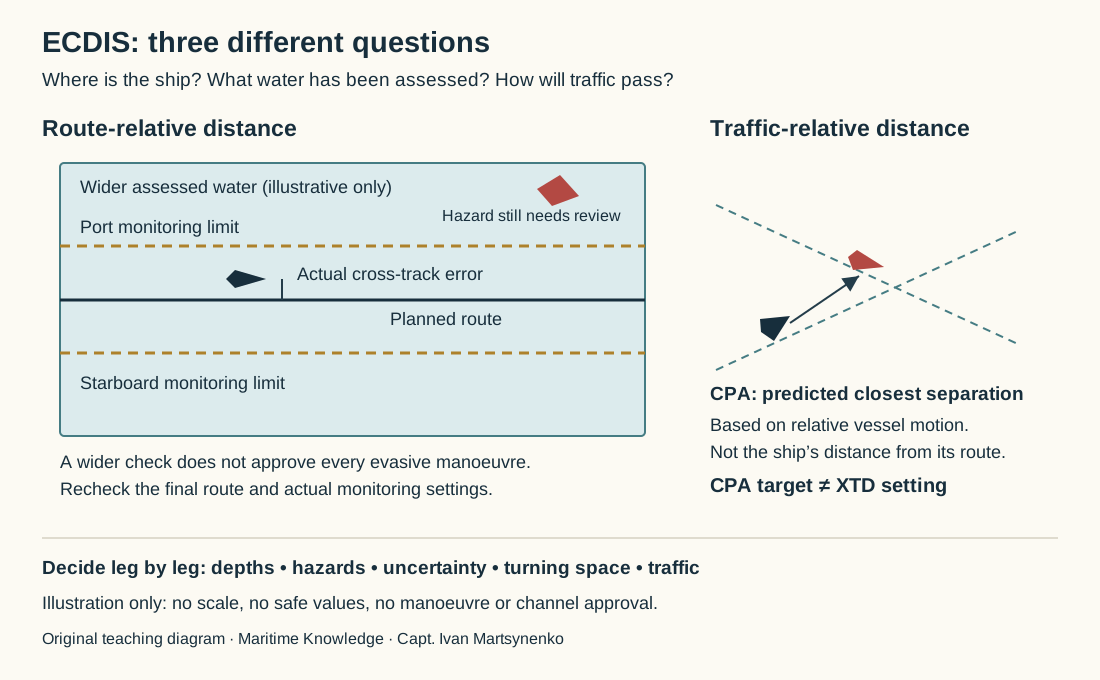
Conceptual diagram only—not a chart, scale drawing, safe manoeuvre or permission to widen a route. A broader planning assessment and the final monitoring limits can have different purposes; establish what the actual equipment checks.
Why XTD does not equal CPA
A 1 NM CPA target does not mean the ship must move 1 NM sideways. Passing separation depends on both tracks, speeds, encounter geometry and any lawful manoeuvre by either vessel. A course or speed alteration may improve CPA with relatively little lateral displacement; another encounter may need more sea room than the selected corridor provides. There is no direct conversion from a CPA target to an XTD setting.
Nevertheless, the alert raises a valid planning question: has the bridge team assessed usable water for foreseeable collision-avoidance actions, and are the standing orders workable in that water? Do not fix an inconsistency by merely widening an alarm. Reconcile traffic instructions, charted hazards, vessel manoeuvrability and call-the-Master triggers during appraisal. Where limits cannot be met safely, escalate and revise the plan through the ship's procedures rather than fabricate compliance.
What the IMO ECDIS standard actually says
For equipment to which IMO MSC.232(82) applies:
- Section 11.3.5: an indication is required if the mariner plans a route across own ship's safety contour.
- Section 11.3.6: an indication is required if the planned route is closer than a user-specified distance to a prohibited area or geographical area with special conditions identified in the standard. Review the system's available chart-danger checks and their settings; these paragraphs do not guarantee detection of every hazard.
- Section 11.3.7: the mariner can specify a cross-track limit at which an automatic off-track alarm is activated.
- Section 11.4.5: an alarm is required when the specified cross-track limit is exceeded.
These are equipment-performance requirements, not a universal corridor width or an instruction to equate CPA and XTD. The resolution does not establish that every manufacturer's automatic route check scans precisely the displayed XTD corridor. Newer applicable ECDIS performance standards and equipment approvals must also be considered; confirm the installation's applicable standard rather than assuming one resolution applies to every unit.
Set the limits leg by leg
Start with the berth-to-berth appraisal and detailed plan; see Passage Planning: APEM.
- Establish the intended track, position uncertainty, chart quality, vessel dimensions and manoeuvring characteristics. Account for wind, current, squat and the ship's approved UKC/depth policy as applicable.
- Identify shoals, dangers, no-go areas, routeing measures, channel/traffic-lane boundaries, wheel-over/turn geometry, tidal constraints and available contingency water. Width alone does not demonstrate clearance through a turn.
- Select meaningful port and starboard limits for each leg where supported. An asymmetric corridor may be necessary; neither side is automatically safe because the other is clear.
- Assess foreseeable traffic encounters and whether standing orders can be met without entering unsafe water. Define escalation, abort and contingency arrangements through the approved process.
- Validate the planned route and final settings, brief the bridge team and retain the relevant evidence. Reassess when conditions or the route change.
A TSS lane boundary is not automatically a safe-water boundary. Do not blindly copy a lane's width, use a very wide open-sea value near a hazard, or choose zero at a berth merely because a historical poster says so. Too-wide limits can delay useful warning; too-narrow limits may produce frequent alarms. Resolve nuisance alarms through proper review, not by silencing or widening them indiscriminately.
Route-check coverage: verify, do not assume
On the actual ECDIS, establish which settings govern the planning check, which govern monitoring alarms, and whether they interact. Consult the maker's manual and approved familiarisation process. Confirm applicable port/starboard widths, turn areas, chart cells and update status, safety contour/depth selections, other danger-check settings and the effect of chart-object data quality.
The circular's maximum-XTD route check may be a supplementary screening step if the equipment uses that width and the result is properly reviewed. It is not a universal IMO requirement, not always an appropriate navigable corridor, and not a substitute for detailed appraisal. A maximum-width scan can contain hazards, uncharted uncertainty, land or restricted water. Findings must be resolved, not dismissed because the final monitoring corridor is smaller.
After any temporary screening settings are restored, verify and recheck the final approved route and actual settings, including port/starboard values and turns. Preserve what was checked, on which equipment, with which charts, widths and safety settings; record significant findings and their resolution, review/approval and bridge briefing under the SMS. Do not claim a clean check means the whole corridor is safe: visual inspection at appropriate scales and chart-quality assessment remain necessary.
Monitoring and an alteration outside the planned corridor
Confirm the intended route and correct leg are active, monitoring parameters are correct, position/reference inputs are credible and alarms are available under the approved checks. Monitor track, traffic, depth/UKC constraints and changing conditions together.
An off-track alarm is a warning to evaluate the situation, not an order to return blindly to the line. COLREGs still govern collision-avoidance duties. An imminent danger must not be ignored to remain inside XTD. Assess safe water and the lawful action, involve the Master under standing orders, and use the vessel's emergency/contingency arrangements when time permits. After an alteration, monitor its effectiveness and the new navigational risks. Any revised route requires the appropriate check, approval and briefing; being inside a previously scanned wide area is not automatic approval of a new track.
Bridge scenarios
- Coastal leg, 1,000 m XTD, 1 NM CPA instruction: do not infer non-compliance or safety from those two numbers alone. Examine the encounter geometry, manoeuvring water, standing orders and escalation arrangements. The company reports a deficiency; its account does not establish a general AMSA numeric rule.
- A wider scan finds a shoal outside the final corridor: identify it as unsafe contingency water and assess whether the route and foreseeable actions remain viable. A narrow final setting does not remove the shoal.
- A turn passes the leg check but approaches a danger: verify the equipment's checking of turns/wheel-over and the vessel's swept path; a straight-leg width cannot establish safe turning clearance.
- Repeated off-track alarms in a channel: investigate position input, route geometry, environmental effects and the approved settings. Do not widen into bank hazards simply to quiet the alarm.
- Traffic action would leave checked water: evaluate collision and grounding risk together, call/escalate under standing orders and act appropriately for the actual danger. Do not treat an alarm boundary as overriding COLREG duties or as proof the alternative water is safe.
Self-test — 8 Questions
- Is the uploaded alert an AMSA-issued rule requiring XTD to equal CPA?
Answer 1
No. It is a Sino Cosmos company circular reporting a disputed inspection. The underlying PSC record and outcome are unverified; its account is not a universal AMSA numeric rule.
- What is the difference between actual XTD, XTL and CPA?
Answer 2
Actual XTD/error is displacement from the planned route; XTL is a selected route-relative limit, sometimes labelled XTD; CPA is predicted closest separation from a target. Check the equipment's terminology and functions.
- Does a 1 NM CPA target require a 1 NM lateral departure?
Answer 3
No. CPA depends on relative tracks, speeds and encounter geometry, not solely own ship's lateral distance from its route. There is no direct CPA-to-XTD conversion.
- Does MSC.232(82) prescribe a safe XTD for all ships?
Answer 4
No. It provides applicable equipment requirements, including a selectable cross-track limit and an alarm when exceeded, not a universal safe width or CPA equality.
- Does the maximum selectable XTD prove safe contingency water?
Answer 5
No. Confirm what the equipment actually checks, assess depths, dangers, uncertainty, turns and restrictions, and resolve findings. A wide screening check cannot approve every manoeuvre.
- What must happen after temporary wider route-check settings are restored?
Answer 6
Verify and recheck the final approved route and actual monitoring/planning settings, including both sides and turns; retain the checked configuration, findings and appropriate review/briefing evidence.
- Why might port and starboard limits differ?
Answer 7
Safe water, hazards, routeing constraints and uncertainty can differ on each side. Select meaningful leg-specific limits under the approved process rather than assume symmetry or adopt a lane width blindly.
- Should an off-track alarm trigger an immediate unassessed return to the line?
Answer 8
No. Assess traffic and safe water, follow COLREG duties and standing orders, and use escalation/contingency arrangements. A blind return can create collision or grounding danger.
Sources and further reading
- Supplied company source: Sino Cosmos Ship Management Limited, HKG, Safety Alert 06/2026, 22 October 2026, Darwin, “XTD / XTL SETTING IN ECDIS”, one page. Reported PSC case and company's recommendations, not an independently verified AMSA notice. PDF/poster not redistributed.
- IMO MSC.232(82), Revised Performance Standards for ECDIS, adopted 5 December 2006; Annex sections 11.3.5–11.3.7 and 11.4.5. Confirm applicability to the installed equipment.
- IMO A.893(21), Guidelines for Voyage Planning, adopted 25 November 1999; appraisal, detailed planning, execution and monitoring. Official resolution text hosted by the Netherlands government.
- IMO electronic charts and ECDIS: performance standards, carriage and implementation context.
- IMO COLREG overview: apply the actual rules and circumstances, not a CPA number alone.
- The installed ECDIS manufacturer's applicable manual, ship's approved SMS and standing orders: operating instructions and actual settings must come from controlled vessel-specific documents.