Scope: Educational selection guidance, not an anchor-sizing tool or an operating procedure. Classes A–G refer to Vryhof's historical 2010 geometry/efficiency groups, not modern class approval grades. No class letter guarantees holding capacity, suitability for uplift or permission to change anchor settings.
Learning objectives
Compare each class in practical conditions; identify evidence needed before choosing an anchor; distinguish ship anchoring from engineered offshore mooring; recognise when to stop setting or reassess the plan.
Start with the anchor-types guide
Open the illustrated anchor-types section: Classes A–G. It shows the named examples and historical geometry groups. Read it alongside this lesson: the pictures identify forms, while selection depends on the actual model, seabed and operating envelope.
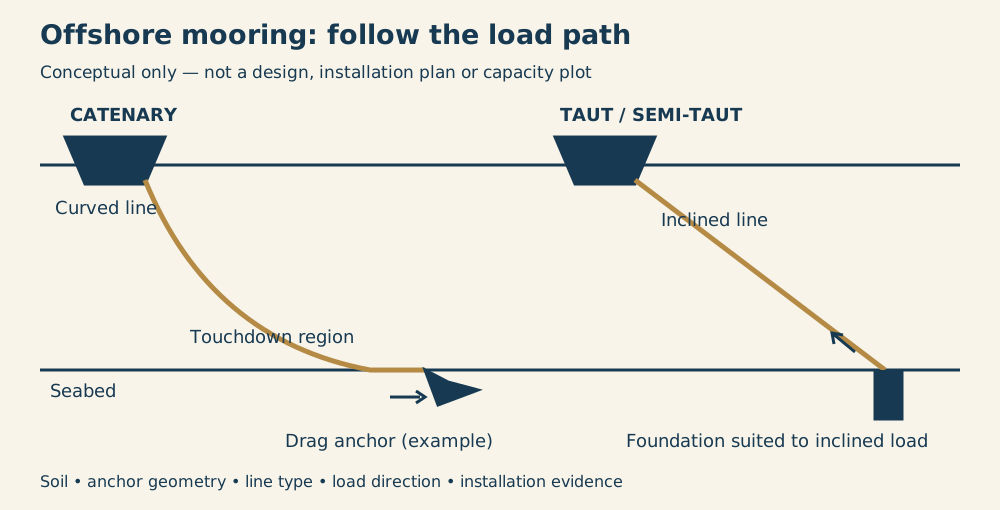
Original teaching diagram. A taut line requires a foundation qualified for its loading; a conventional drag anchor is not automatically suitable.
First define the job, not the class letter
An approved ship's bower anchor used during a temporary anchorage is not selected in the same way as a permanent offshore foundation. For a vessel, check the installed certified arrangement, anchorage plan, depth, swinging room, traffic, weather, bottom information and vessel procedures. For engineered offshore mooring, obtain the geotechnical profile, design load cases, mooring layout, line behaviour, anchor qualification and installation acceptance criteria. Temporary service does not remove the need for a risk assessment.
Do not select by the source's holding-to-weight ratios alone. Neither a historical letter nor a familiar product name establishes HHP/SHHP approval of the actual anchor.
Choosing and using each historical class
Class A — deep penetration is useful only when achievable
Examples: Stevpris, Stevshark, FFTS. Consider an appropriately qualified model when the site analysis calls for efficient drag embedment and the soil profile permits it. Soft clay can allow substantial penetration, but strength, layering and cyclic demand still control holding. Dense layers or buried obstructions can prevent the intended embedment.
In use: confirm the correct certified configuration, a clear drag corridor, planned load direction and the specified setting/acceptance records. Do not assume every Class A design accepts uplift, reversed pull or the same fluke angle.
Class B — elbowed geometry is not a universal seabed solution
Examples: Bruce SS, Bruce TS, Hook. These bent-shank forms were grouped for their penetration geometry. They are candidates only where model-specific evidence supports the ground and loading—not a general recommendation for rocks, weed or every clay deposit.
In use: check the model, configuration and handling interfaces before deployment. Unexpected drag or poor setting calls for the approved reassessment response, not an improvised higher winch load.
Class C — check stabilisation and the actual penetration
Examples: Stevin, Stevfix, Stevmud, Flipper Delta. Short shanks, crown-hinge geometry and stabilisers are visual features of this group. Selection requires evidence that the anchor will establish the intended attitude and embed in the site's soil. “Stevmud” is a historical name, not confirmation that any mud is suitable.
In use: check hinges, flukes and stabilising elements for damage or restricted movement where applicable to the model. Use installation evidence to assess setting; do not infer successful penetration from the anchor disappearing below the surface.
Class D — a stock and long shank still need suitable ground
Examples: Danforth, LWT, Moorfast/Stato/Offdrill, Boss. A qualified fluke anchor may be appropriate in penetrable sand or clay when its design envelope matches the job. Hard crusts, rock, weed and rapid changes in pull can interfere with setting or sustained holding; performance must be established for the model.
In use: allow for the stock, shank and flukes in stowage and handling. Where pull direction changes, assess the possibility of breakout and re-setting rather than assuming uninterrupted holding. Do not treat all products grouped beside one drawing as identical.
Class E — compact geometry and certification are separate questions
Examples: AC14, Stokes, Snugstow, Weldhold. Compact stockless-style forms can be relevant to a ship's installed anchoring arrangement, but their approval, dimensions and suitability must be checked against that vessel and anchor certificate. A convenient stowage shape is not evidence of offshore-foundation capacity.
In use: inspect the actual crown/fluke arrangement, securing and handling clearances. Monitor vessel position and conditions using the vessel's approved anchoring procedure; do not choose a new anchor from appearance alone.
Class F — conventional stockless service is not an offshore guarantee
Examples: US Navy Stockless, Beyers, Union, Spek. These crown-stabilised stockless forms illustrate conventional anchor geometry. They may be used within an approved ship anchoring system; the lower historical efficiency grouping does not make a certified arrangement automatically unsafe, nor does large mass ensure holding in unsuitable ground.
In use: check free movement of applicable moving parts, condition, securing and the whole cable/windlass arrangement. If dragging is suspected, follow the bridge's contingency plan; additional cable or engine assistance is not a universal cure.
Class G — specialised geometry needs a defined purpose
Examples: Single Fluke Stock, Stock, Dredger, Mooring Anchor. Stocked and specialised forms can have roles in vessel, dredging or mooring arrangements when selected and qualified for that purpose. Small fluke area and intended orientation matter; the historical “Dredger” or “Mooring Anchor” label is not an approval for a modern project.
In use: assess orientation, projecting parts, deck handling and retrieval. A traditional stocked anchor must not be assumed to be a rock anchor or a substitute for a designed piled/suction foundation.
Real-condition decisions
| Situation | Selection question | Safe teaching conclusion |
|---|---|---|
| Soft clay at an offshore site | Can the model penetrate to the intended depth, and what soil strength and cyclic resistance are available? | A–C examples may illustrate penetration-based designs, but choose from verified site/model evidence, not the letter |
| Penetrable sand | What do testing/design records show for density, setting distance and load direction? | Suitable fluke designs exist in several groups; no single historical class is automatically best |
| Rock, boulders or hard crust | Can the selected anchor establish reliable resistance without snagging or uncontrolled damage? | Do not presume any A–G form will work; reassess the location or foundation concept with competent designers |
| Tidal reversal or changing weather | How will rotating/reversing pull affect breakout, line layout and re-setting? | Assess the complete arrangement and contingency plan; do not assume continuous holding through reversal |
| Taut mooring with inclined load | Is the foundation qualified for the actual horizontal/vertical load combination? | Consider appropriate plate, pile or suction designs when required; conventional drag geometry is not uplift approval |
| Limited space around infrastructure | Is there a safe drag corridor, swing envelope and retrieval route? | Capacity alone cannot resolve a collision, subsea-clearance or anchor-handling constraint |
Controlled use: plan, set, verify, monitor, retrieve
- Plan: identify the actual anchor and certificates; agree ground, load cases, clearances, weather limits, roles and stop criteria. Use the vessel SMS and project-specific method.
- Prepare: inspect the anchor, connectors and line; verify permitted configuration and handling compatibility. Do not change fluke angles from a generic lesson.
- Set or install: follow the approved sequence and keep personnel clear of loaded lines, bights and recoil zones. No generic tension, speed, scope ratio or setting distance is prescribed here.
- Verify: compare recorded position, movement and applicable load evidence with the approved acceptance criteria. Factory proof-load evidence is structural evidence, not site holding proof.
- Monitor: watch position, load trends where available, conditions and changes in pull. Unexpected movement, abnormal load or lost communications triggers the agreed stop/contingency response.
- Retrieve: use the approved breakout and recovery method; allow for snagging, high breakout forces, stern loading and vessel stability. Do not improvise around a stuck anchor.
Current manufacturer examples: why the model matters
Current product guidance illustrates why historical letters cannot prescribe real operations:
- STEVPRIS Mk6: the manufacturer relates configuration to soil conditions and describes uplift acceptance as case-by-case. Do not interpret this as Class A-wide permission or change settings without the approved procedure.
- STEVSHARK REX: a purpose-designed hard-ground product addresses difficult and layered conditions. Its stated applications do not establish that every historical Stevshark or every Class A anchor is suitable for arbitrary rock or boulders.
- STEVMANTA: a vertical-load anchor that changes from drag-installation mode to vertical-service mode. Being installed by dragging does not make an ordinary drag anchor equivalent to this specialised design.
- Current Vryhof Manual access page: lists soil survey, selection, installation monitoring and proof-load topics. The detailed manual is access-gated; its procedures were not reviewed for this lesson.
These current manufacturer pages were checked 7 November 2026. They illustrate product-specific engineering distinctions; they do not validate historical class-wide holding, reversal or retrieval limits.
Master's note
Ask: “What will this anchor do in this ground, under this direction of pull, and what evidence confirms it?” A good-looking fluke and a class letter do not answer those questions.
Sources and related lessons
- Vryhof Anchors B.V., Anchor Manual 2010 — The Guide to Anchoring: supplied printed pages 14–20 provide the A–G groups; the earlier lesson's reviewed theory and handling extracts support the general selection questions. Historical manufacturer guidance, not current class rules.
- Illustrated anchor types and offshore mooring fundamentals — class pictures, broader foundation families, historical efficiency cautions and original source attribution.
- Vryhof manufacturer website — obtain current documents for the exact product; this lesson does not assert current model availability or certification.
- Bollard Pull Test Procedure — vessel pulling capability does not prove installed anchor holding.
- Turnbuckles and Rigging Inspection — component condition and traceability.
Self-test
- Which class is always best in soft clay?
Answer 1
None can be selected universally. Actual soil strength/layering, penetration, cyclic demand and the model's qualified performance govern selection.
- Can a Class A letter prove that an anchor accepts uplift?
Answer 2
No. It is a historical geometry/efficiency group. Inclined loading requires model-specific qualification and approved analysis.
- What should be checked before using a Class D fluke anchor in sand?
Answer 3
The actual model and certificate, sand conditions, setting evidence, load direction, clearances and the approved operational plan.
- Does an AC14 name or a Class E label prove HHP approval?
Answer 4
No. Check the actual certified anchor and vessel arrangement; a name or historical class is insufficient.
- Does large mass make a Class F anchor reliable on hard rock?
Answer 5
No. Reliable resistance must be established for the actual ground and arrangement; weight does not guarantee setting.
- What must be considered if the tidal pull reverses?
Answer 6
Breakout/re-setting behaviour, changing load direction, line and swing geometry, and the approved monitoring and contingency plan.
- What does factory proof testing fail to prove?
Answer 7
It does not prove seabed holding capacity or successful installation at the chosen site.
- What should happen after unexpected drag or abnormal installation load?
Answer 8
Follow the agreed stop-and-assess or contingency procedure and obtain competent review. Do not improvise higher tension or anchor settings from this lesson.