Source and scope: Original teaching notes informed by One Sea, Autonomous Ships and Safety at Sea, with a foreword by Capt. Eero Lehtovaara, Chairman of One Sea. All 14 pages of the uploaded white paper were reviewed 7 November 2026. The publication discusses 2021 developments and future milestones; no explicit publication date was found in the extracted text, so its year is not asserted here. It presents industry perspectives, not binding law, proof of safety or the current MASS regulatory framework. Subsequent rules, products and insurance terms were not verified in this review.
Learning objectives
Explain why automation does not automatically improve safety; identify risks across the vessel–shore system; distinguish operator competence, technical assurance and legal approval; recognise claims in an industry white paper that need qualification.
The safety promise—and the evidence it needs
One Sea argues that automation and autonomous technologies may reduce exposure to hazardous tasks, improve situational awareness and support operational efficiency. These are potential benefits, not guaranteed outcomes. A new system can remove one hazard while introducing others: incorrect sensor interpretation, hidden software faults, degraded communications or unclear human responsibility.
The useful question is not “Is autonomy safer?” in isolation. It is “Safer for this function, vessel, operating area and failure condition—and demonstrated by what evidence?”
Automation, autonomy and remote operation
| Concept | What changes | What does not follow automatically |
|---|---|---|
| Automated function | A defined task is performed by a system | The whole vessel is autonomous |
| Autonomous function | A system interprets information and selects actions within its designed scope | It can safely handle every unfamiliar situation |
| Remote operation | Human control is exercised from another location | The vessel has no human involvement |
| Uncrewed operation | Crew are not physically aboard | Legal duties, human work and emergency arrangements disappear |
The white paper stresses cooperation between capable people and technology. Its employment predictions should be treated as opinions, not promises that autonomy will either preserve every job or eliminate seafarers.
Follow the whole safety chain
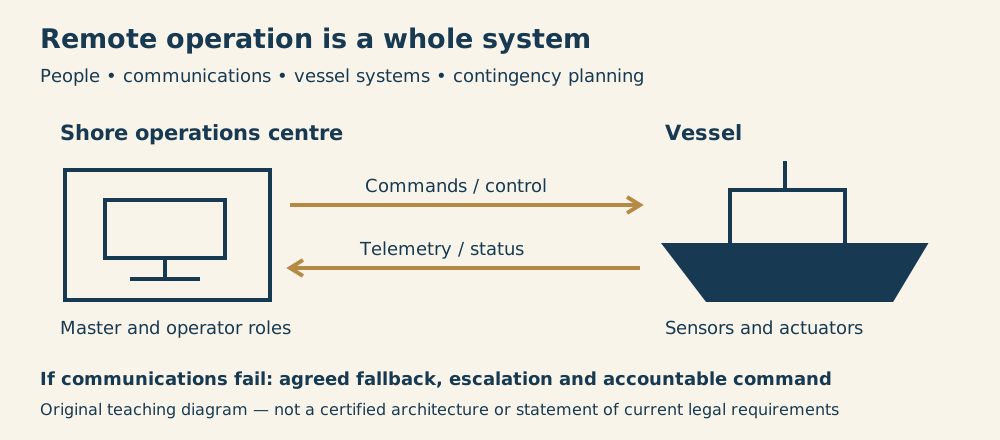
Diagram illustrates remote-operation interfaces; it is not a universal architecture for every autonomous vessel or an approved safety design.
Safety chain: Operating limits → sensing → interpretation → decision → action → monitoring.
Human oversight and intervention apply across that chain, supported by cyber resilience, records and contingency arrangements.
Assurance must examine both the components and their integration. Individually reliable sensors, software and communications can still interact unsafely. Shared power, common software or a common communications provider can introduce dependencies that a component-by-component check misses.
A practical hazard map
| Hazard | Learning questions |
|---|---|
| Missing or misleading sensor data | How is uncertainty detected? What independent information is available? |
| Link loss or latency | Which functions remain available? Who knows that control is degraded? |
| Automation bias | Can the operator recognise an implausible recommendation and intervene? |
| Ambiguous handover | Who has command and who may issue control instructions now? |
| Cyber compromise | Can an attacker alter data, commands or system availability? |
| Shore-centre disruption | What happens after local power loss, fire or loss of staffing? |
| Unfamiliar traffic or environmental conditions | Is the vessel still within its validated operating limits? |
| Emergency aboard an uncrewed vessel | How are fire, flooding, distress and intervention addressed? |
These are original study prompts, not a complete statutory checklist. Fallback actions must be specific to the operation; simply stopping or anchoring is not always safe.
Cybersecurity: more than a compliance document
The white paper warns against treating cybersecurity as a one-off compliance exercise. Integration of equipment from different suppliers can create gaps unless the complete data and control paths are understood. Access control, trustworthy updates, monitoring, supplier interfaces and recovery arrangements need to be considered together.
Its discussion of cyber incidents and named vessels is historical context, not evidence that a particular vessel or supplier is secure today. A cyber incident can become a physical safety event when it affects navigation, propulsion or remote control.
People and competence remain central
Remote operators can lose information that a person aboard would perceive directly. They may also receive more consolidated information than a traditional bridge team. Neither arrangement is automatically superior. Workload, training, fatigue, alarm interpretation, handover and emergency intervention must fit the actual task.
A shore operator's comfortable location does not make the risk less real. Clear responsibility and accurate situational awareness matter whether control is aboard or ashore.
Classification and approval are different questions
One Sea describes class societies assessing individual functions and the integrated system. Technical assurance should consider intended operation, hazards, validation and failure behaviour. Class assessment does not by itself replace flag-State, coastal-State or port permissions, nor prove that every operation is legal.
A claim such as “99.99% correct software” is not an operational safety assessment. Reliability depends on the defined function, failure severity, test coverage and system behaviour—not a count of apparently correct lines of code.
Insurance: check the actual contract
The paper raises hull-and-machinery, P&I, cyber exclusions, shore-centre jurisdiction and liability allocation. These are useful questions, but its broad statements should not be applied to every policy today.
- Check actual policy wording, exclusions, endorsements and insurer agreement to the intended operation.
- Distinguish malicious cyber activity from accidental software or system failure; they may be treated differently.
- Clarify vessel, operator, shore-centre and supplier responsibilities without assuming liability automatically shifts to one party.
- Do not assume every cyber event is excluded, every autonomous vessel is uninsurable, or loss of cover automatically cancels every class or registration status.
Obtain operation-specific legal and insurance advice. This lesson does not interpret a reader’s policy.
Source claims that should not be repeated unqualified
| White-paper issue | Safer teaching statement |
|---|---|
| Suggestion that COLREG instructions only apply when ships are visually observable | COLREG applicability is broader. Part B Section II concerns vessels in sight; Section III addresses restricted visibility, and Rule 5 is not limited to vessels in sight |
| General statements about compulsory insurance and invalidation of class/registration | Obligations depend on applicable law, certificates, contracts and conditions; avoid a universal rule |
| Broad claims about cyber exclusions and P&I requiring a fully manned vessel | Coverage and operating approval require checking actual terms and the approved arrangement |
| Future dates for deployment or regulatory progress | Historical expectations are not proof that milestones were achieved |
| General claims that humans and automation together are always better | Benefit must be demonstrated for the particular function and operating conditions |
This is a critical reading of the supplied paper, not a current official-source verification of the whole autonomous-shipping framework.
Master’s note
New technology earns trust through clear limits, demonstrated behaviour and competent intervention. Ask who is accountable, what can fail, how failure is detected, and what approved response remains available.
Sources and connected lessons
- One Sea, Autonomous Ships and Safety at Sea, uploaded 14-page white paper: safety framework p. 4; cyber security p. 5; operator and human roles pp. 6–8; insurance pp. 9–11; classification pp. 12–13; next steps p. 14. Foreword: Capt. Eero Lehtovaara. Publication date not confirmed. The PDF and third-party photographs are not redistributed because reuse permission was not established.
- One Sea publisher website — address printed in the white paper; current destination not independently checked.
- Maritime Autonomy and Remote Operations — the UK 2021 consultation and its historical-policy limits.
- COLREG Five Parts, Bridge Watchkeeping, Marine Insurance and Flag State Guide.
Self-test
- Does introducing an autonomous function automatically prove that a vessel is safer?
Answer 1
No. Benefits and new hazards must be assessed for the function, operating limits, integration and failure conditions.
- What is the difference between remote operation and uncrewed operation?
Answer 2
Remote operation describes where human control is exercised; uncrewed describes the absence of crew aboard. One does not define the other.
- Why must safety assurance examine the integrated system?
Answer 3
Interactions and shared dependencies can create hazards even when individual components perform well.
- What is automation bias?
Answer 4
Over-trusting automated information or recommendations instead of critically assessing whether they fit the actual situation.
- Does a class assessment alone supply every permission needed for an operation?
Answer 5
No. Applicable flag, coastal and port requirements and operation-specific approvals remain separate questions.
- Can this white paper determine whether a reader’s cyber loss is insured?
Answer 6
No. The actual policy, exclusions, endorsements and circumstances must be reviewed with the insurer and qualified advisers.
- Are COLREGs limited to ships that can see each other visually?
Answer 7
No. Vessels-in-sight rules are one section; the regulations also address restricted visibility and general duties such as a proper lookout.
- Why should the white paper’s future milestones be treated cautiously?
Answer 8
They are historical expectations. Their achievement and subsequent legal developments were not verified in this lesson.