Historical policy source — not current law: This lesson explains the UK Department for Transport publication Future of transport regulatory review consultation: Maritime autonomy and remote operations (2021). The full 27-page uploaded consultation was reviewed 7 November 2026. Its proposals and questions must not be read as enacted requirements, approved operating permissions or the current international MASS framework. A sourced comparison below checks selected MCA and IMO developments as at 7 November 2026; it is not a complete legal or vessel-approval assessment.
Learning objectives
Distinguish remote operation from autonomy; explain the relationship between vessel, remote operator and shore centre; identify why command, communications, security and liability matter; recognise the difference between consultation proposals and binding law.
Remote operation is not the same as autonomy
A remotely operated vessel has a human controlling a function from another location. An autonomous system can make decisions and operate without human input within its designed scope. A vessel may combine onboard crew, remote functions and automated systems during different parts of a voyage.
| Concept | Original explanation | Important distinction |
|---|---|---|
| Remote operation | A human controls a vessel function from elsewhere | Physical distance does not eliminate human involvement |
| Autonomy | A system makes operational decisions without direct human input within its scope | Automation of one function does not establish whole-vessel autonomy |
| Uncrewed vessel | No crew are physically aboard | It may still be remotely controlled by people |
| MASS | Maritime Autonomous Surface Ships | The consultation proposed broad coverage of navigation craft with autonomous or remotely operated functions; that proposal is not a universal enacted definition |
| Remote Operations Centre (ROC) | Location from which remote operators perform vessel operations | Shore equipment and people are part of the safety system |
Dynamic Positioning is an example of automation, but fitting DP alone does not demonstrate that a vessel is uncrewed or fully autonomous.
The proposed accountability chain
The consultation sought a person or entity accountable for the vessel at all times, including emergencies. It proposed a MASS master defined by command or charge rather than physical location, with a separate broad remote-operator role that could include that master. These were proposals, not permission for a conventional ship’s master to leave the vessel.
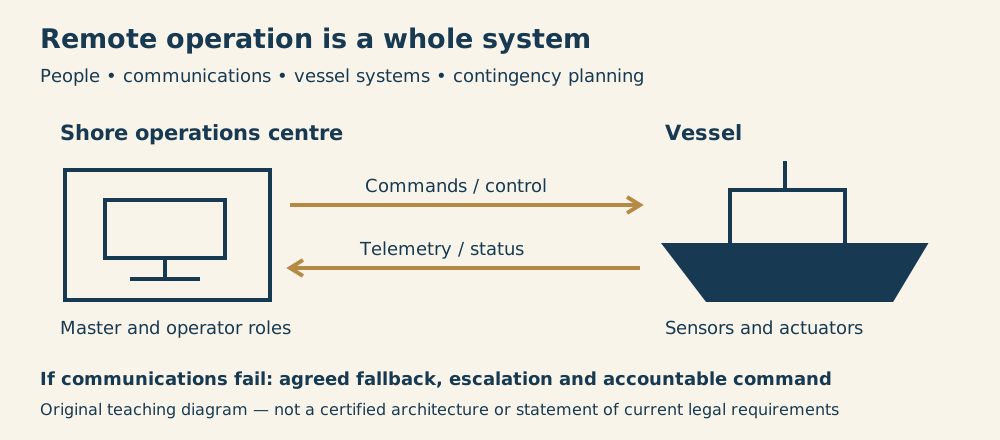
Conceptual teaching diagram, not a certified system architecture.
The report explicitly distinguished this proposed arrangement from the continued need for a master aboard a non-MASS vessel. The identity of the person issuing a control command and the identity of the person holding overall command need to be clear; they need not describe identical duties.
Why regulate the shore centre?
Moving a control station ashore moves work and risks—not just screens. The 2021 consultation proposed powers enabling the MCA to address ROCs and remote safe-manning principles. Operator qualifications, training and watchkeeping rest arrangements were matters for later development.
For learning purposes, useful operational questions include:
- Who currently has command and who may send control instructions?
- How is control transferred, acknowledged and recorded?
- What information reaches the operator, with what latency and reliability?
- What happens if the link, sensors, power or shore centre fails?
- Who can intervene, and how are port authorities and emergency responders informed?
These are original study prompts, not statutory requirements or a complete approval checklist. A fallback must suit the vessel and operating area; there is no universal instruction to stop, anchor or continue when a link fails.
What the 2021 consultation proposed
| Area | Historical proposal or question |
|---|---|
| Definitions and roles | Clarify ships/craft, MASS, command and remote operators |
| Small craft | Enable regulation of craft that might fall outside traditional ship definitions |
| ROCs | Establish powers for safe operation and management ashore |
| Ports and harbours | Examine local definitions and powers while recognising devolved administration and harbour-specific legislation |
| Underwater apparatus | Consider future powers for autonomous or unmanned submersible systems; these are not surface ships |
| Equipment | Consider new equipment and possible assessment of software/algorithms separately from hardware |
| Security | Address physical and cyber threats to vessels and shore centres |
| Insurance and liability | Examine gaps in responsibility, compensation and insurance arrangements |
| Test areas | Seek views about designated testing arrangements rather than grant automatic approval |
Some ROC questions included location in the flag State. A consultation question is not evidence of a blanket legal requirement that every ROC must be in the flag State.
2021 proposals compared with current requirements
Source check: 7 November 2026. The 2021 document was a consultation, not an operating permission. The Department for Transport’s consultation and government response distinguish proposed reforms from implementation. The subsequent framework is not one universal rulebook: vessel type, flag, operating area and approval route still matter. The sources checked here do not establish that every proposed UK legislative change has been enacted.
| Topic | What the 2021 report proposed | Current position supported by official sources | Practical distinction |
|---|---|---|---|
| Scope and definitions | Broader coverage of autonomous/remote craft and clearer MASS roles | Workboat Code Edition 3 provides a specific small-workboat/pilot-boat pathway, including remotely operated unmanned vessels (ROUVs); it is not a universal rule for every MASS [1, 2] | Do not apply a small-workboat certification route automatically to a SOLAS cargo ship or another vessel class |
| Master and command | A MASS master defined by command rather than physical location | MGN 703 discusses the ROUV master and protects the master's safety decisions within its Workboat Code scope. IMO's adopted MASS Code also retains the master's overall responsibility, even when not aboard, but the Code itself is non-mandatory [2, 4] | Neither source grants a general right for a conventional ship's master to move ashore |
| Shore centre and personnel | ROC regulation, safe manning and remote-operator qualifications | MGN 703 addresses competent personnel, ROC/vessel familiarisation, watchkeeping support and contingencies for Workboat Code ROUVs. It says manned-vessel training/certification requirements apply under Annex 2, 7.2.4 [2] | Remote operation does not mean unqualified operation; the guidance does not establish a worldwide ROC licensing scheme |
| Technical assurance and trials | New equipment/software assessment and possible designated test areas | MGN 664 Amendment 1 sets out a risk-based certification process supplementing existing regulations. It calls for early engagement with relevant authorities; non-UK vessels within its scope need UK administration agreement before operating in UK waters [3] | A test project or an innovative system is not automatically approved for commercial operation |
| Security and loss of control | Extend attention to physical/cyber security of MASS and ROCs | MGN 664 addresses safety, environmental and security risks; MGN 703 includes maritime cybersecurity training and operational contingencies. The IMO MASS Code emphasises cybersecurity, connectivity and ROC integration [2, 3, 4] | Assess the vessel and shore system together; these sources do not prove that all 2021 security proposals became law |
| International alignment | Develop domestic reform alongside IMO work | IMO adopted the MASS Code in May 2026, effective from 1 July 2026 as a non-mandatory instrument for cargo ships covered by SOLAS Chapter I. SOLAS and other applicable mandatory IMO instruments still apply [4] | Non-mandatory does not mean unregulated; the Code supplements rather than replaces applicable mandatory duties |
UK rules already applicable versus guidance still developing
Workboat Code Edition 3: the MCA states that new covered workboats and pilot boats must use it from 13 December 2023, read with SI 2023 No. 1216. Existing certificated vessels have transition provisions: compliance by the next renewal examination or three years after entry into force, whichever is later, subject to the Code's specified exceptions. Therefore, do not describe all existing vessels as already obliged to meet every Edition 3 provision on the same date. [1]
Remote-operator competence: MGN 703 is guidance for ROUVs certified under that Code, not a universal new operator licence. Sections 3–5 assign responsibilities to owners/operators for qualified, competent personnel and vessel/ROC-specific training. Section 1.3 says national remote-operator standards are being developed. MCA's June 2025 Remote Operator training and certification framework is labelled a pilot; that publication alone does not establish a fully implemented mandatory certification scheme for all remote operators. [2]
Adopted now versus planned later: IMO MASS Code
- May 2026: IMO adopted the non-mandatory MASS Code.
- 1 July 2026: the non-mandatory Code took effect. Its stated scope is cargo ships covered by SOLAS Chapter I, not every uncrewed craft.
- December 2026: IMO plans work on the experience-building framework; this is still future work at this lesson's review date.
- 2028: planned development of the mandatory Code and consideration of SOLAS amendments.
- By 1 July 2030 / 1 January 2032: IMO's roadmap expects mandatory-code adoption by the former date and entry into force on the latter. These are future milestones, not present binding requirements or a guarantee of final adoption. [4]
Before a real operation: confirm the applicable flag, coastal and port/harbour requirements, vessel certification route, accepted safety evidence, master/remote-operator arrangements and operation-specific contingency procedures. This section does not verify a comprehensive new UK MASS statute, every local harbour rule, or the final implementation status of every remote-operator pilot measure. Do not infer permission or an exemption from a consultation, guidance note or international roadmap.
Official sources for the comparison
- [1] MCA — Workboat Code Edition 3: scope, entry date and existing-vessel transition provisions; the publication links the full Code and identifies SI 2023 No. 1216.
- [2] MCA — MGN 703: training and competence of remote operators working with Workboat Code ROUVs: sections 1, 3, 4 and 5; interim standards, owner/operator responsibilities, command, contingencies and training.
- [3] MCA — MGN 664 Amendment 1: certification process for vessels using innovative technology: sections 1–3; supplementary risk-based process, applicability and authority engagement.
- [4] IMO — IMO adopts first global Code for autonomous ships, 22 May 2026: adopted non-mandatory status, SOLAS cargo-ship scope, human oversight and roadmap towards binding rules. See also IMO's autonomous-shipping FAQ.
Cybersecurity is also a navigational concern
A compromised remote-control link can affect a vessel’s physical actions. The consultation discussed extending security coverage to MASS and ROCs, including unauthorised seizure of control. Learning should consider identity and access controls, system integrity, communications resilience and response to a suspected compromise—but this lesson does not prescribe a certified cybersecurity solution.
Software assurance matters because the decision-making or control logic may run on different hardware. Merely replacing a conventional wheelhouse with remote displays does not establish that equipment, software or operations are approved.
Insurance, liability and familiar maritime duties
The report discussed pollution, passenger injury, wreck removal and limitation of liability in the context of existing international instruments. It anticipated that the new operating arrangements could require legal changes and suitable insurance products. Do not assume that responsibility transfers automatically to a software supplier or disappears because nobody is aboard.
The consultation also identified SAR obligations, wreck/salvage and domestic Port State Control as areas it did not then consider needed amendment to permit MASS operations. That was its 2021 policy assessment—not an exemption from those duties, and not confirmation of their current detailed application.
Practical scenario: a link degrades near a port
A remote operator sees delayed position and traffic information. The teaching priorities are to recognise degraded situational awareness, identify who has command, follow the approved contingency arrangements and coordinate with the relevant parties. The safe action depends on the operating area, control capability, onboard arrangements and approvals. Do not invent a manoeuvre from a generic lesson.
Master’s note
Ask three questions: “Who is accountable?”, “Who has control now?” and “What is the approved response when that control or information is lost?” A new operating model needs clear answers, not merely a new label.
Source, licence and related lessons
- Department for Transport (2021): Original 27-page consultation reference; no public copy is provided. Key sections: definitions and responsibilities pp. 7–9; legislative proposals pp. 10–11; ports/equipment/security/liability pp. 14–18; test areas and other issues pp. 19–20.
- Contains public sector information licensed under the Open Government Licence v3.0, except where otherwise stated. © Crown copyright 2021. No government endorsement is implied; third-party material retains its own rights.
- UK Department for Transport — publisher website identified in the source. See the dated comparison below for the specific current sources reviewed.
- Bridge Equipment, Bridge Watchkeeping, Dynamic Positioning, Marine Insurance and Flag State Guide.
Self-test
- Is remote operation the same as operation without human involvement?
Answer 1
No. A human controls a function from another location. Autonomy concerns decision-making without direct human input within a system’s scope.
- Does an uncrewed vessel have to be fully autonomous?
Answer 2
No. It can be remotely controlled by people ashore or elsewhere.
- Did the 2021 consultation enact a right for a conventional ship’s master to remain ashore?
Answer 3
No. It proposed a location-independent MASS-master role and explicitly distinguished non-MASS vessels. Consultation proposals are not enacted permissions.
- Why is the ROC part of the safety system?
Answer 4
Its operators, equipment, communications and control arrangements affect vessel actions, situational awareness and emergency response.
- Does the source establish that every ROC must be located in the flag State?
Answer 5
No. Location in the flag State was among consultation propositions, not proof of a universal binding requirement.
- Does this lesson prescribe a universal manoeuvre when communications fail?
Answer 6
No. The response must follow vessel- and area-specific approved contingency arrangements, considering actual control and safety conditions.
- Do autonomy and remote operation automatically remove insurance or SAR obligations?
Answer 7
No. The report examined liability and existing duties; changing the operating model is not an automatic exemption.
- What must be checked before relying on this document for a real operation today?
Answer 8
Current applicable law, flag and coastal/port State requirements, approvals, equipment assurance and operation-specific procedures. This 2021 consultation alone is insufficient.