On an offshore installation or support vessel, major incidents rarely begin with an exotic system failure. More often they grow out of routine daily work — a loose hatch in a rising swell, an unguarded deck opening, an unseized shackle pin on staging, a live radar switched on while a crew member works aloft, or grease left to accumulate in a galley hood.
This lesson brings together the core day-to-day safety controls overseen by an Offshore Installation Manager (OIM), Master and deck supervisors: preparing for heavy weather, managing vessel access and personnel transfers, controlling deck housekeeping and lighting, supervising work aloft and maintenance tools, handling chemicals and pressure equipment, and maintaining galley discipline.
Operational boundary: This guide is for general maritime and offshore awareness. On board, the vessel or installation Safety Management System (SMS), Permit-to-Work (PTW) system, flag State regulations (such as the UK MCA Code of Safe Working Practices for Merchant Seafarers — COSWP), class rules and equipment manufacturer manuals always govern.
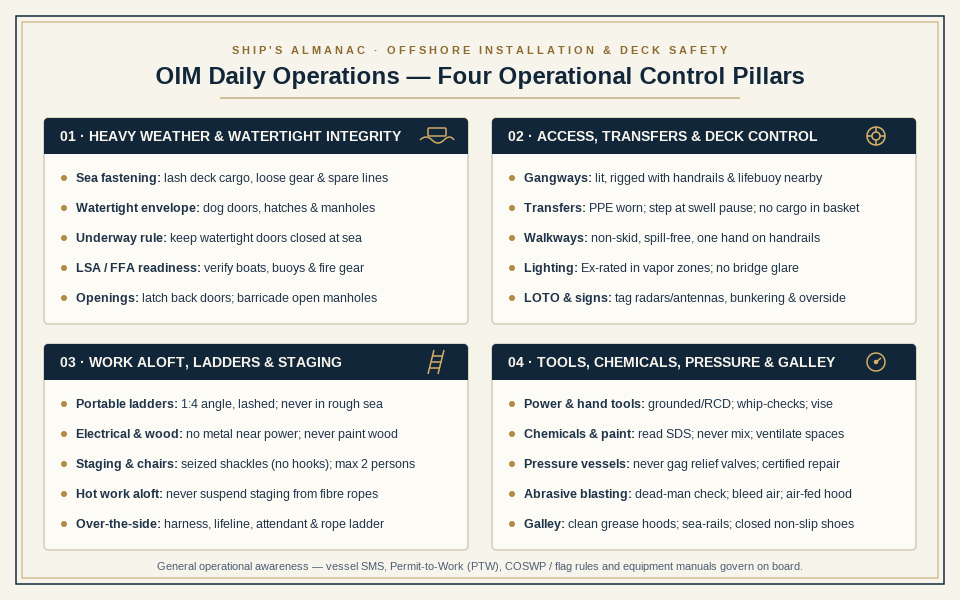
1. Heavy Weather and Watertight Integrity
When severe weather, tropical storms or heavy seas are forecast, securing the unit is a deliberate, verified routine rather than a last-minute rush:
- Sea fastening: Secure all mooring and working lines, loose deck gear, gas bottles, containers and deck cargo before vessel motion increases.
- Weathertight and watertight envelope: Close and dog down exterior doors, hatches, scuttles and manholes. Maintain the seals and dogs of watertight doors and hatches at all times, and keep watertight doors closed while underway in accordance with the vessel's stability booklet and SMS.
- Emergency readiness: Confirm that life-saving appliances (LSA) and fire-fighting equipment (FFA) are properly stowed, unobstructed and ready for immediate deployment.
- Everyday door and opening discipline: Even in fair weather, latch or hook back open doors and hatches so a sudden roll cannot slam them onto a hand or foot. Keep doorways and escape routes clear of gear, and barricade or rope off any open manhole before leaving it unattended; cover manholes whenever they are not in active use.
2. Vessel Access, Personnel Transfers and Warning Controls
Safe Access to Vessels
Safe embarkation and disembarkation — whether dock-to-vessel or vessel-to-vessel — requires physical protection and clear visibility:
- Rig a sound, well-lit gangway or accommodation ladder fitted with handrails; inspect bulwark ladders to confirm they are properly secured and structurally sound.
- Check the immediate landing area for oil, ice, loose lines or tripping hazards before personnel cross.
- Station a lifebuoy fitted with a buoyant line and self-igniting light immediately adjacent to the gangway.
- Wear an approved work vest or lifejacket whenever embarking, disembarking or crossing between vessels alongside each other, especially where a formal gangway cannot be rigged.
Personnel Transfers Offshore
Moving crew between a supply vessel and an installation, or between vessels, is one of the highest-exposure daily tasks offshore:
- Wear the required personal flotation equipment (floater suit or lifejacket) both when transferring and when tending the transfer on deck.
- When stepping across at a boat landing or between vessels, wait for the brief pause at the peak of the vessel's rise on the swell rather than jumping down onto a falling deck.
- Personnel transfer carriers (baskets): Never load cargo or stores into a personnel transfer carrier — it is for people and personal baggage only. On traditional collapsible rope transfer baskets, riders stand on the outer rim facing inward with personal bags stowed in the centre, and remain on the rim until the crane operator sets the basket solidly on deck. Where a modern rigid-frame carrier (such as a FROG or seated Billy Pugh unit) is used, follow the manufacturer's seating, harness and briefing instructions and the installation's transfer procedure.
Lighting and Hazardous Areas
- Illuminate all active walkways, stairways and working decks, while ensuring deck floodlights do not impair bridge night vision or mask navigation lights.
- Carry a torch when entering unlit spaces; protect portable extension leads from chafing against sharp coamings or steel edges.
- Guard fixed light fittings in machinery and deck spaces against impact breakage. In areas where flammable vapours or gases may be present, use only certified explosion-proof (Ex-rated) luminaires with intact guards.
Warning Signs and Lock-Out / Tag-Out (LOTO)
- Post and obey hazard and escape-route signs; if any sign is unclear, verify its meaning with a ship's officer before entering the area.
- Post clear warning notices whenever crew are working over the side, and display "No Smoking, No Open Lights, No Visitors" notices during bunkering or fuel transfer.
- Before anyone works aloft near radar scanners or radio transmitting antennas, isolate the equipment and apply formal Lock-Out / Tag-Out (LOTO) controls with warning tags at the bridge/radio controls so transmitters cannot be energized accidentally.
- Keep all fire-fighting and life-saving stations clearly marked for rapid identification.
3. Deck Surfaces, Walkways and Preventing Slips, Trips and Falls
Slips, trips and falls remain a leading cause of lost-time injuries at sea. Effective control relies on housekeeping, engineering and personal discipline:
- Traction and visibility: Maintain non-skid coatings on fixed ladders, stair treads and high-traffic deck routes. High-visibility paint on stair nosings and good stairway lighting reduce missteps.
- Movement habits: Never run on deck or inside accommodation; always walk, watch your footing and keep one hand free to hold handrails on stairs (standard handrails should be fitted on stairs of four or more steps). In icy or snowy weather, keep hands out of pockets so you can steady yourself.
- Spills and deck hazards: Clean up spilled oil, grease, soap or water immediately. Avoid walking across wet, oily, waxed or icy surfaces where possible, and fit non-slip backing on any mats placed near stairways.
- Tripping hazards: Do not leave tools, shackles or stores on walkways. Route hoses and electrical leads overhead whenever practicable; where they must cross a walkway, secure and mark them cleanly. Stay alert for loose deck plates, mooring lines and transfer hoses.
- Footing under load: When pulling hard on a wrench or bar, brace your stance so a sudden slip or release will not throw you into machinery or over a coaming.
- Temporary deck openings and work at height: Before removing any floor plate, grating or hatch cover, barricade or rope off the opening and keep it guarded or attended. Use appropriate fall-arrest harnesses and lifelines whenever working over the side, on unguarded edges (such as barges, stacked cargo or tank tops) or above the fall-protection height specified in your vessel SMS (traditional offshore checklists cite 6 ft / ~1.8 m, while many international SMS and COSWP rules specify 2.0 m or any exposed drop — always apply the stricter local rule).
4. Ladders, Staging, Painting and Chemical Safety
Portable and Rope Ladders
- Never use portable straight, extension or step ladders on a vessel underway or standing by in rough sea conditions.
- Set straight or extension ladders at roughly a 1:4 ratio (base out one-quarter of the vertical height), inspect top and bottom contact surfaces for slip, and lash both top and bottom before climbing.
- Face the ladder, keep both hands on the side rails while climbing, hoist tools in a bag or bucket, allow only one person at a time, and never climb with greasy or wet boots. Do not stand above the third rung from the top on a straight/extension ladder or the second tread from the top on a stepladder. Fully spread and lock stepladders before use, and never lay a ladder horizontally as a plank.
- Never use metal ladders near live electrical equipment. Never paint a wooden ladder — opaque paint hides cracks and rot. Discard defective ladders immediately.
- On rope ladders, verify rung end-seizings, fit spreaders to prevent twisting, secure the head to structural deck fittings rather than guardrails, test before use, and mouse (seize) every shackle pin with wire.
Scaffolds, Staging and Boatswain's Chairs
- Inspect all rigging, lines, planks and fittings before every use; never improvise staging on barrels, boxes, crates or homemade rigging.
- Suspend staging and boatswain's chairs with shackles whose pins are seized with wire — never open steel hooks.
- Limit staging to at most two workers, and wear a full safety harness with an independent lifeline. Never use fibre-rope supports when staging is used for welding, burning or hot work.
- In a boatswain's chair, exercise extreme care when self-hauling or lowering to prevent fingers from being drawn into blocks or lines, and maintain positive control whenever holding your own weight.
Over-the-Side Painting, Cleaning and Hazardous Chemicals
- For over-the-side painting or maintenance, post a dedicated attendant with a lifebuoy and line nearby, wear a harness and lifeline, and rig a rope ladder beside each stage or boatswain's chair.
- Ensure adequate mechanical or natural ventilation before painting or cleaning in enclosed spaces. During spray painting, wear the specified respirator, goggles and skin protection; if spraying inside a machinery space, shut down machinery and ventilate thoroughly. Never immerse a pressurized spray or wash-down gun into a bucket while air pressure remains on the system.
- Always read the product label and Safety Data Sheet (SDS, formerly MSDS) before handling paints, thinners or cleaning chemicals. Never mix cleaning agents (mixing incompatible chemicals such as bleach and acids can release toxic gas).
- Use a paddle — not hands or makeshift metal rods — to stir paint. Enforce strict no-smoking rules during painting, mixing or inside the paint locker. Never use carbon tetrachloride or petrol/gasoline as cleaning solvents, and avoid unapproved hydrochloric-acid cleaners.
- When handling acids, caustics or strong cleaning solutions, wear splash-proof goggles, chemical gloves and a face shield. If skin or eyes are splashed, flush immediately with copious clean water and follow SDS medical guidance.
5. Power Tools, Hand Tools, Pressure Vessels and Abrasive Blasting
Power Tools (Electric and Pneumatic)
- Ensure crew receive proper officer instruction before operating power tools, and wear task-appropriate PPE (face shield or goggles, gloves, hearing protection and safety footwear).
- Disconnect power before changing discs, blades or bits. Verify electrical tools are properly grounded (or double-insulated) and never use electric tools in wet conditions or near combustible liquids or vapours. When electric tools must be used over the side, protect the circuit with a Ground Fault Circuit Interrupter (GFCI / RCD).
- Remove patched, frayed or damaged leads from service immediately, route cords clear of the work zone, and remove loose clothing, rings and chains that could catch in rotating parts.
- On pneumatic tools, secure air-hose couplings with safety clips and whip-checks to prevent accidental disconnection and hose whip.
Hand Tools
- Use the right tool for the task and retire broken or mushroomed tools rather than improvising (never strike blows with a wrench or screwdriver).
- Cut away from the body with knives; clamp workpieces in a vise instead of holding them in one hand while using a screwdriver.
- Never carry sharp tools in pockets or hold tools in your hand while climbing a ladder — use a tool pouch, bucket or lanyard, especially aloft or over the side. Never throw tools to another person.
- Use certified non-sparking tools when working in areas where flammable vapours or explosive atmospheres may exist.
Pressure Vessels and Abrasive Blasting
- Never gag, choke or tamper with a pressure relief valve, and never allow operating pressure to exceed the vessel's Maximum Allowable Working Pressure (MAWP).
- Protect air receivers and pressure tanks from external corrosion by maintaining their coating systems, and drain internal condensation regularly.
- Never attempt makeshift repairs to a pressure vessel shell (such as welding inserts or drilling and plugging); pressure-boundary repairs may only be carried out by certified repair facilities under class/flag oversight. Protect vessel-mounted gauges and valves from impact, and discharge portable pressurized tanks before transport wherever practicable.
- Abrasive blasting (historically called sandblasting): Secure all air-hose couplings with whip-checks, test the handle's "dead-man" control before starting, and bleed all air pressure off the lines before breaking any hose connection. Wear a supplied-air blasting hood with a clean visor, gloves, long sleeves, trousers and safety footwear, and point the nozzle strictly at the work surface. (Modern offshore safety standards restrict or prohibit dry crystalline silica sand because of silicosis risk — use approved silica-free blasting media per your SMS and SDS.)
6. Galley Safety
The galley combines hot oil, boiling liquids, sharp knives, electrical appliances and a moving deck:
- Decks and footwear: Clean up grease, water and food spills immediately. Wear proper closed, non-slip working footwear — never slippers, sandals or rubber shower shoes.
- Stoves and hot liquids: Secure pots and pans with sea-rails (fiddles) while underway. Use dry hot pads and aprons when handling hot pans or frying, lower food carefully into hot grease to avoid splashes, and test hot water before immersing hands.
- Movement and handling: Never run in the galley, never carry trays or stores that block your line of sight, and never stand on boxes or crates to reach high shelves. Sweep up broken glass or crockery with a broom and dustpan — never pick up shards by hand.
- Fire and hygiene controls: Wash range hoods and grease filters regularly so flammable grease cannot ignite in the exhaust duct. Avoid steel wool for scouring (loose strands cause cuts and can contaminate food). Inspect galley fire extinguishers and fire blankets frequently and ensure galley staff know how to tackle a deep-fat fire safely (never use water on burning cooking oil).
Related Lessons in This Library
- Preventing Maritime Incidents: Navigation, Cargo, Mooring and Control of Work
- SOLAS Fire Safety: Structure of a Shipboard Response
- Marine Hydraulic Cylinder Maintenance: Isolation, Seals and Inspection
- Turnbuckles and Rigging Inspection: Load Ratings, Stored Energy and Traceability
References
- UK Maritime and Coastguard Agency (MCA): Code of Safe Working Practices for Merchant Seafarers (COSWP)
- International Maritime Organization (IMO): International Safety Management (ISM) Code
- International Labour Organization (ILO): Accident Prevention on Board Ship at Sea and in Port
- UK Health and Safety Executive (HSE): Offshore Health and Safety Guidance
Self-test
- Before heavy weather arrives, which three immediate deck and vessel preparations should be verified?
Answer 1
Secure all lines, loose gear and deck cargo; close and dog down doors, hatches and manholes (maintaining watertight integrity); and confirm all life-saving and fire-fighting equipment is in place and ready for immediate use.
- When transferring personnel offshore using a personnel transfer basket, what rules apply to cargo and stepping off?
Answer 2
Never load cargo or stores into a personnel transfer carrier (it is for people and personal baggage only), and wait until the crane operator sets the carrier solidly on deck before stepping off, following the specific carrier's posture/seating procedure.
- What precautions are required before crew work aloft near radar scanners or radio antennas?
Answer 3
Isolate the radar and radio transmitters, apply formal Lock-Out / Tag-Out (LOTO) controls and post clear warning signs at the operating stations so the equipment cannot be energized while crew are working near the scanners or antennas.
- Why should a wooden ladder never be painted, and what is the correct setup ratio for a straight portable ladder?
Answer 4
Opaque paint can hide cracks, splits or rot in the wood; a straight or extension ladder should be set at roughly a 1:4 angle (base out one-quarter of the vertical height), inspected for slip and lashed top and bottom.
- How must scaffolds, staging and boatswain's chairs be suspended, and what rope restriction applies during hot work?
Answer 5
Suspend them with shackles whose pins are seized (moused) with wire — never open steel hooks — and never use fibre-rope supports when staging is used as a platform for welding, burning or other hot work.
- What electrical and pneumatic precautions apply to portable power tools on deck or over the side?
Answer 6
Disconnect power before changing accessories, keep electric tools grounded and out of wet or combustible-vapour areas, use a Ground Fault Circuit Interrupter (GFCI/RCD) over the side, and secure pneumatic air-hose couplings with whip-checks to prevent hose whip.
- What are the non-negotiable safety rules for pressure vessels and abrasive-blasting hoses?
Answer 7
Never choke or gag a relief valve, never exceed MAWP, and never attempt makeshift welding or plugging repairs (certified repair shops only). Before abrasive blasting, test the dead-man handle control, secure couplings, wear a supplied-air hood, and bleed all air pressure from the lines before breaking any hose connection.
- Why must galley range hoods and filters be washed regularly, and what footwear is prohibited in the galley?
Answer 8
Grease accumulation in range hoods and filters is a major galley fire hazard; slippers, sandals and rubber shower shoes are prohibited — closed, non-slip working footwear is required to protect against slips, spills and hot liquids.