Source, revision and safety boundary
This original companion uses the supplied IMCA R 021, Guidance for Remotely Operated Vehicle Load Testing and Inspection, October 2016, attributed to the International Marine Contractors Association. All 18 PDF pages were reviewed, including the subsea-package and miscellaneous-equipment tables. The upload’s filename indicates a third-party download source; its authenticity and completeness are not established by the filename or branding. The uploaded PDF, page images and tables are not redistributed.
On 7 November 2026, IMCA’s official publication page lists Recommended practice for remotely operated vehicle load testing and inspection, R021, Rev. 1.3, August 2024. Its history identifies October 2016 as initial publication. This lesson explains principles from the supplied historical edition; it does not claim the 2016 tables reproduce the current revision. Obtain the authorised applicable edition and check current manufacturer, class, flag, coastal-state and workplace requirements.
Safety boundary: this is awareness material, not a lifting plan, inspection certificate, load-test procedure or permission to alter/re-terminate equipment. Only authorised competent personnel should determine the applicable examination/test programme and release. Never perform an improvised overload test, retorque loaded connections, remove a securing pin under tension or dismantle an unsupported package. Control stored hydraulic, electrical and mechanical energy under the installation’s approved arrangements.
What R021 covers
The supplied Section 1 addresses lifting-related equipment associated with ROV mobilisation, demobilisation and operation: lifting points and frames, lifting cable/wire rope, accessories, ROV/TMS packages and tooling interfaces. It excludes manned vehicles and design criteria. It assumes equipment has an appropriate design basis and is fit for its intended environment.
An ROV is an unmanned underwater vehicle operated from the surface. The TMS, or tether management system, manages the vehicle’s tether and may be a cage or top-hat arrangement. LARS is the launch and recovery system. The operational ROV system includes these and surface controls/support equipment, but one component’s certificate does not accept the whole installed system.
Do not apply ROV lifting guidance as approval for carrying divers or other personnel. Manned diving recovery and pressure systems need their own rules and acceptance; see the diving-systems lesson.
Trace every load path—not just the main hook
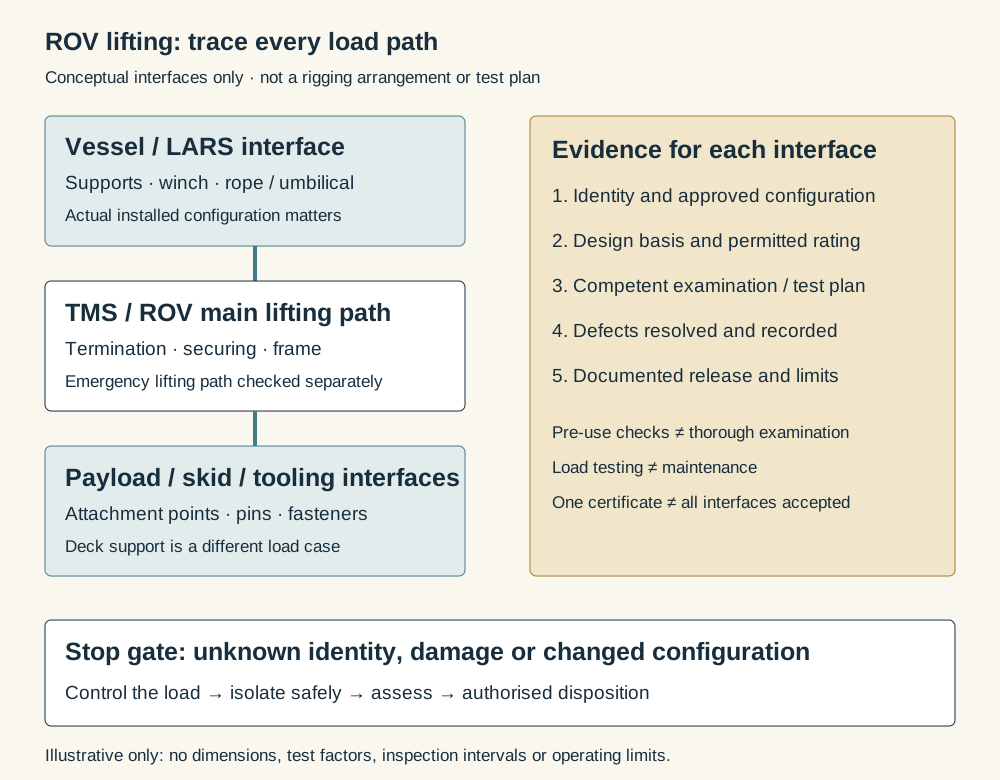
Original interface diagram, not a physical rigging arrangement. Some ROVs deploy inside a garage TMS and do not have the same separate main lifting points; use the actual system drawing. The sequence shown does not imply all equipment is always suspended together.
| Part of the arrangement | What to establish |
|---|---|
| Vessel and LARS interface | Approved supports/attachment arrangements, winch and lifting-line scope, installation condition and operating envelope |
| TMS load path | Main and emergency lifting points, termination retention, docking interfaces and frame condition |
| ROV load path | Main/emergency attachment arrangements, frame, actual payload and approved configuration |
| Skid/backpack/tooling | Attachment points, pins/fasteners, permitted loading and whether a separate lifting or deck-support case applies |
| Maintenance stands/trestles | Designed support arrangement, condition and approved load—not just a sling’s tension rating |
| Accessories | Correct sling/shackle identity, rating, configuration, condition and compatible connections |
The 2016 Appendix 3 treats ROV, TMS, underslung skid and backpack interfaces separately. Appendix 4 includes maintenance supports and subsea synthetic slings. A tidy main frame cannot clear an unchecked emergency lifting point, damaged skid pin or unidentified recovery sling.
Inspection, examination and testing are different
| Activity | Purpose and boundary |
|---|---|
| Pre-use inspection | Identify obvious defects, insecure attachments, mismatch or deterioration before the lift; not a substitute for required competent examination |
| Thorough/competent examination | Systematic assessment using appropriate methods and a written record/report within the applicable regime |
| NDE | Non-destructive examination selected for the material, defect mechanism and access; qualified method and interpretation are needed |
| Functional test | Check intended operation such as controls, brakes or movement under the defined procedure; it does not establish every structural rating |
| Static/load test | Apply a specified controlled load case under an authorised plan; may support acceptance but does not replace design evidence or examination |
| Maintenance | Preserve or restore function/condition under approved instructions; not itself independent examination or permission to release |
The historical tables use V for visual inspection, VN for visual plus NDE, and T for proof-load test plus NDE and visual inspection. These are that guide’s record categories, not universal markings or interchangeable certificates. When that programme requires NDE before and after testing, the result of both stages matters.
HSE’s thorough-examination guidance distinguishes detailed competent examination from routine checks and recognises testing where the competent person considers it appropriate. UK LOLER is a jurisdiction-specific example—not the complete legal regime for every seagoing vessel or offshore operation.
Why there is no universal test multiplier
A test plan must establish which component, load direction, installed arrangement, rating definition, tare/payload and design basis it is verifying. DAF, dynamic amplification factor, accounts for the selected dynamic-loading assumptions; it is not an arbitrary spare safety margin.
The supplied 2016 tables contain different expressions for initial and periodic checks, different allowances for package mass, and separate compression cases. Do not turn a table’s mixture of “mass” and “SWL” into arithmetic without checking definitions and units. A hanging load test and a deck-support compression test are not the same load case. Determine the forces and application points from the accepted design and current instructions.
This lesson deliberately supplies no generic proof-load multiplier, torque value, DAF, inspection percentage or test duration. A successful overload test cannot invent an unknown WLL, repair damage or prove every dynamic operating condition. Repeated unnecessary overload testing can itself create risk or damage.
A controlled test needs an authorised method, competent supervision, suitable calibrated measurement equipment, defined load application, supports/restraints, exclusion zones, acceptance criteria and post-test examination/reporting as applicable. Personnel must not be exposed to a suspended package, recoil or a failing fixture while testing.
Competence is task-specific
Sections 5–6 and Appendix 1 describe competence through appropriate training, current skill, knowledge and experience, and identify different categories of examiner/test specialist. Job title alone does not establish competence for every test, NDE method or structural assessment. Where an owner’s employee carries out an examination, their role must allow professional independence; applicable law may impose additional restrictions.
A resin-socketing course is relevant to particular termination tasks, but it does not automatically qualify someone to certify an entire ROV system. Match the personnel and authority to the specific work. See resin socketing and socket inspection.
Intervals, dormancy and change control
The supplied 2016 Sections 7–8 and Appendices 2–4 use different schedules for portable structures, subsea packages, supports and accessories. They include routine/annual checks and longer-cycle testing for defined items. These are historical, equipment-specific recommendations, not one statutory inspection interval for all ROV equipment. The applicable current programme, conditions and certificate/examination scheme control due dates; deterioration or an abnormal event can demand earlier action.
Section 7.2’s long-term installation discussion is not permission to resume lifting on expired evidence. It addresses unused lifting arrangements and maintenance; where certification has lapsed, the specified examination, testing and recertification are needed before reuse in lifting. Confirm the current applicable requirement and actual condition before planning the next mobilisation.
After a changed skid, heavier payload, altered lifting point, new vessel installation, repair, shock load, prolonged disuse or suspected damage, reassess scope and required examination/test evidence. Original design certification does not normally have an expiry date in the 2016 explanation, but that is conditional on the design and integrity remaining valid. It is not lifetime permission to operate unchanged paperwork after changes or deterioration.
Defects and inspection access
Watch for suspected cracks, deformation, corrosion/pitting, damaged weld areas, rope/termination movement, insecure retention, unsuitable pins or missing identity. Subsea slings require checks for their specific construction, exposure and condition. A current date on a certificate does not clear newly observed damage.
The 2016 Appendix 3 notes the risk created by stripping buoyancy or handling an unstable package just to inspect it. Plan safe access and appropriate examination methods; do not interpret that risk assessment as permission to leave a critical part unexamined. Use an approved alternative or keep the equipment out of service if integrity cannot be established.
The same appendix explicitly cautions not to drill into the ROV core lifting frame to fit a data plate. Identification must be secured by an approved method without an unauthorised structural alteration. Do not weld or stamp a critical part merely to tidy the records.
Records that support release
Sections 6–10 distinguish original/design evidence from periodic examination/test records and maintenance history. Match every record to the actual serial/plant identity and configuration.
A useful acceptance record identifies the equipment and relevant attachments; procedure/revision and sections; permitted rating, tare/gross load where relevant; inspection/test type and applied loads; date/location; competent person’s name/signature; findings, limitations, due basis and authorised disposition. Retain original records and subsequent evidence so the offshore team can demonstrate traceability and readiness. A scan with the wrong serial number is not valid evidence for the item at hand.
Real-condition decisions
- In-date certificate, newly bent emergency padeye: stop reliance on that path, control the load and obtain competent assessment. Do not wait until the next scheduled examination.
- A heavier tooling skid is fitted: verify payload, interfaces and the accepted configuration; a certificate for the old package does not cover the change by default.
- A dormant frame is needed for demobilisation: resolve lapsed lifting evidence, condition and required checks before the lift, not after mobilisation starts.
- A fastener is loose during a suspended operation: do not retorque it under load from this lesson. Make the arrangement safe using the approved plan, preserve evidence and obtain the required assessment.
- A proof test passes but a post-test crack is found: no release. Follow the applicable defect-control and disposition process; a pass reading cannot override damage.
Self-test — 8 Questions
- Does R021 provide a design code or approval for manned vehicles?
Answer 1
No. The supplied scope addresses ROV-related lifting examination/testing and excludes design criteria and manned vehicles. Design suitability and manned-system requirements must be established separately.
- What load paths need consideration beyond the main ROV lifting point?
Answer 2
The installed LARS interface, TMS and emergency lifting paths, terminations/retention, skid and backpack attachments, support frames/stands and relevant accessories must be assessed for the actual configuration.
- Does a pre-use check replace a required competent examination?
Answer 3
No. Routine checks, competent examination, NDE, load testing and maintenance have different purposes. Follow the applicable programme and retain the required findings/report.
- Can one generic proof-load multiplier be applied to every ROV component?
Answer 4
No. Identify the component, load direction, rating definitions, tare/payload, units, configuration and accepted design/current test basis. A static lift test and a compression case are different.
- May a current certificate justify use after fresh damage is found?
Answer 5
No. Stop further use of suspect equipment, control the load safely and obtain competent assessment and documented disposition. A date does not clear a defect.
- Does long-term dormancy permit lifting with lapsed evidence?
Answer 6
No. Resolve the applicable examination/testing/recertification requirements and actual condition before returning dormant equipment to lifting service.
- Does fitting a heavier skid leave the original accepted configuration unchanged?
Answer 7
No. Reassess mass, attachment loads, interfaces and design/acceptance scope, then obtain required updated evidence and release before use.
- Why is a successful proof test not enough if examination finds damage?
Answer 8
Testing does not override defects or establish an unknown rating. Resolve examination findings against the applicable criteria and retain authorised release/disposition evidence; otherwise keep the equipment out of use.
Sources and further reading
- Supplied historical reference: IMCA R 021, Guidance for Remotely Operated Vehicle Load Testing and Inspection, October 2016, Sections 1–10 and Appendices 1–4, 18-page third-party copy. Authenticity/current applicability not assumed; copy not redistributed.
- IMCA official R021 publication: currently lists Rev. 1.3, August 2024; obtain the authorised applicable text and revision history.
- IMCA ROV system inspection: separate wider system-inspection guidance; do not confuse its scope with R021.
- HSE thorough examinations and inspections of lifting equipment: competence, reports, examination and testing distinctions in the applicable UK context.
- DNV Rules and Standards Explorer: establish current relevant design/class standards rather than adopting the 2016 guide’s historical DNV GL numbering without verification.