About this lesson
An original introduction and critical reading of Cintoo’s Five compelling reasons digital twins are a critical tool for energy companies. All 11 pages of the uploaded paper were reviewed on 7 November 2026. No publication date or individual author is clearly identified in the extracted document; attribution is to Cintoo. This is a vendor publication, not an independent safety standard or verified performance study.
The maritime examples below are original teaching examples, not Cintoo case-study results. The source PDF and third-party illustrations are not redistributed.
Learning objectives
- Distinguish an asset-linked digital twin from an unconnected model or scan.
- Explain five potential benefits and the evidence needed to support them.
- Identify data-quality, cybersecurity and safety boundaries.
- Evaluate promotional forecasts without treating them as measured outcomes.
1. What is a digital twin?
A digital twin is a digital representation associated with an identifiable physical asset, system or process and updated with relevant information about it. Depending on purpose, this may include survey geometry, asset records, operating measurements and models used for analysis.
Cintoo describes real-time mirroring. In practice, the update frequency and fidelity must be stated: a periodic scan is a record of conditions at the survey date, while sensor streams may update much more frequently. Neither guarantees that every displayed detail reflects the current plant.
| Representation | What it offers | What it does not automatically provide |
|---|---|---|
| Static drawing or 3D design model | Design intent and geometry | Evidence of actual installed condition |
| Laser scan or reality capture | Surveyed geometry at a particular time | Live machinery health, hidden condition or current isolation state |
| Asset-linked digital twin | A representation connected to identified assets and relevant updates | Perfect accuracy, validated prediction or authority to control equipment |
| Simulation model | What-if calculations within model assumptions | Proof that the physical asset will behave exactly as simulated |
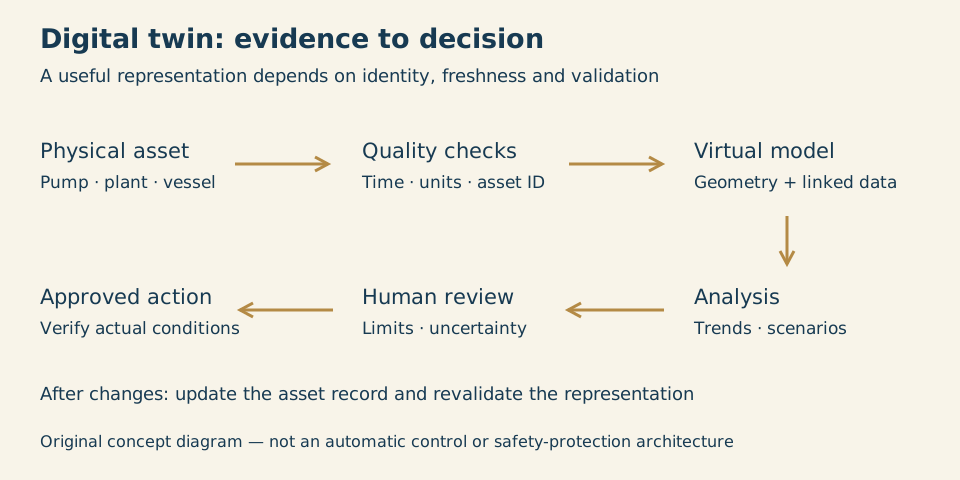
The value lies in reliable connections and decisions, not merely a realistic picture. This is not a control or protection architecture.
2. Five potential benefits—translated into offshore practice
Cintoo groups its argument around efficiency, decisions, safety, sustainability and financial performance. Each is a potential outcome, not a guarantee.
| Benefit | Original maritime or offshore example | Evidence needed |
|---|---|---|
| Better maintenance efficiency | Link pump identity, operating trends and maintenance history to support investigation and job planning. | Reliable instrumentation, model validation and comparison with actual faults and downtime. |
| Shared decision-making | Shore engineers and shipboard staff review the same surveyed machinery-space arrangement before a modification. | Current survey date, controlled revisions, correct asset IDs and confirmed dimensions. |
| Risk reduction | Plan access and identify apparent congestion around an offshore maintenance worksite before travel. | On-site verification, risk assessment and approved work controls; geometry alone cannot prove safety. |
| Resource and energy efficiency | Compare operating scenarios for auxiliary machinery or an offshore facility. | Consistent boundaries, calibrated measurements and verified savings after implementation. |
| Better financial decisions | Compare retrofit options and outage plans before committing resources. | Full lifecycle costs, explicit uncertainty and measured outcomes—not assumed vendor ROI. |
3. Condition monitoring is not automatic fault prediction
A twin may combine measurements with expected behaviour to flag discrepancies. Useful predictive maintenance requires evidence that the method works for the relevant equipment, failure modes and operating conditions. Missing or biased data can create both missed faults and false alarms.
A single high temperature does not prove a specific defect. Compare load, sensor health and other indications, then follow the maker’s instructions and vessel procedures. Do not replace statutory surveys, mandatory tests or prescribed maintenance solely because a dashboard looks normal.
See Maritime Automation: Machinery Monitoring and Ship Simulation for residuals, analytical redundancy and diagnosis limits.
4. Reality capture and remote collaboration
The paper presents Cintoo as a hub for reality-capture information that can connect to digital-twin technology. It reports that BP used the platform to improve virtual access, project work and travel efficiency. These are vendor-reported case-study benefits, not independently verified outcomes for every installation.
A scan can help teams inspect visible layout, locate equipment and plan survey questions. It cannot reliably show a concealed defect, a present gas atmosphere, the live status of a valve or whether stored energy has been isolated. Survey resolution, occlusion and modifications since capture limit what can be inferred.
Illustrative planning scenario: a shore engineer reviews an engine-room scan before arranging removal of a pump. The crew still confirms current clearances, weights, access restrictions and approved lifting arrangements aboard. A plausible virtual lift path is not an approved lifting plan.
5. Keep the safety boundary intact
A digital twin may support decisions or generate alerts, but does not automatically qualify as an independent safety system. Any integration with operational commands needs its own approved design, change control and validation. Do not assume an advisory model can replace protective trips, emergency shutdowns or competent watchkeeping.
Before relying on a displayed result, ask:
- Is this the correct physical asset and configuration?
- When were geometry and measurements last updated?
- Are units, timestamps and sensor quality consistent?
- Has the model been validated for this operating condition?
- What happens when information is stale or communication is lost?
- Who can change the data, assumptions or model?
- Which procedure governs the actual work or operational response?
6. Governance and cybersecurity
Assign ownership for asset records, survey revisions, sensor mapping and model approval. Record modifications so an old arrangement is not mistaken for the current one. Preserve traceability of inputs and decisions.
Remote access introduces security obligations. Apply appropriate access control, network separation, change management and secure handling of facility drawings and operating data. A convenient collaboration platform should not create an uncontrolled route to operational machinery or expose sensitive infrastructure information.
7. Read the numerical claims critically
The paper quotes a digital-twin market forecast of USD 17.73 billion in 2024 rising to USD 259.32 billion in 2032, with 39.8% CAGR, and names Fortune Business Insights. These are market forecasts, not proof of operational value.
Its displayed intermediate chart values do not follow a consistent 39.8% annual compound-growth path from the stated starting value. They should not be reused as validated year-by-year estimates. The chart is omitted here.
The paper also cites up to 20% less unplanned downtime, 18–24 months to positive ROI, and a Gartner prediction about companies without effective governance by 2025. These are source-reported claims or historical projections; the underlying studies and their methods were not independently verified in this lesson. The 2025 prediction is not evidence that its forecast came true.
For a real project, establish a baseline, specify the assets and failure modes, account for deployment and operating costs, and measure the result. Do not substitute a market-growth forecast for a business case or promise those percentages to a ship operator.
8. Links to the wider library
- Marine automation and monitoring: measurements, estimates and fault supervision.
- Oil and gas field life cycle: the facilities and activities a twin may represent.
- Offshore wind installation vessels: planning still requires approved lift and vessel procedures.
- Autonomous ships and safety at sea: assess technology claims against evidence and responsibility.
Self-test
- Does every 3D model qualify as an operational digital twin?
Answer 1
No. A static model may show design intent but lack an identifiable connection to the physical asset and relevant updates. State the representation’s purpose and limits.
- Why is the survey or update date important?
Answer 2
It establishes data freshness. Modifications or changed operating conditions can make old geometry or measurements misleading.
- Can a laser scan prove that equipment is safely isolated?
Answer 3
No. A scan records visible geometry at a particular time. Approved isolation, verification and work controls must establish the real equipment condition.
- Name two conditions needed for useful predictive maintenance.
Answer 4
Examples include reliable asset-linked measurements, representative operating data, a validated model, known failure modes and demonstrated performance under relevant conditions.
- Does a digital twin automatically replace protective trips or statutory inspections?
Answer 5
No. Advisory representations do not automatically qualify as protective systems or replace required inspections, tests and maintenance.
- What evidence is needed before claiming energy savings?
Answer 6
A consistent measurement boundary and baseline, reliable measurements and verified post-change results. A model prediction alone does not establish achieved savings.
- How should the paper’s downtime and ROI figures be presented?
Answer 7
As source-reported vendor claims whose underlying studies were not independently verified, not guaranteed outcomes for another installation.
- What is wrong with treating a realistic simulation as an approved work plan?
Answer 8
A simulation depends on assumptions and may omit present hazards or constraints. Actual work needs current verification and the applicable approved procedures.
Source and review note
Cintoo — Five compelling reasons digital twins are a critical tool for energy companies, uploaded 11-page vendor paper, reviewed 7 November 2026. Publication date not established. Publisher: Cintoo.
The paper’s cited sources include Fortune Business Insights, Astute Analytica, Microsoft’s Azure Digital Twins announcement and Frost & Sullivan. These links identify the references supplied by the paper; availability and underlying numerical claims were not independently verified. The review date is not a regulatory or product certification.