About this lesson
An original introduction inspired by Automation for the Maritime Industries, edited by Joaquín Aranda, Manuel A. Armada and Jesús M. de la Cruz, first published in 2004 by the Instituto de Automática Industrial, CSIC, Spain. The uploaded book was reviewed through its first 50 PDF pages: front matter, the engine-monitoring chapter and part of the passenger-flow chapter. Later chapters are identified from the contents only, not presented as reviewed material.
This is historical research context, not a current class standard, machinery instruction or evacuation approval. The restricted book and its illustrations are not redistributed.
Learning objectives
- Distinguish measurement, estimation, supervision and control.
- Explain why a sensor–model discrepancy needs investigation.
- Compare hardware and analytical redundancy without confusing either with DP redundancy groups.
- Recognise the assumptions and limitations of shipboard simulation.
1. Automation is more than an automatic command
A monitoring system assesses condition; a controller acts to maintain a target; protective functions act within their approved design to prevent an unsafe condition. Their boundaries matter when a fault develops.
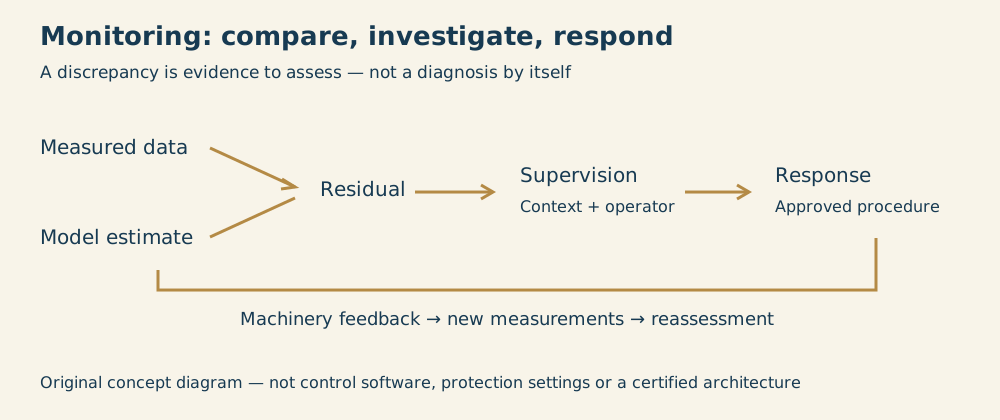
Conceptual monitoring loop, not a certified architecture or instructions for automatic recovery.
| Function | Practical question | Limitation |
|---|---|---|
| Measurement | What does the instrument report? | Calibration, wiring and sensor health affect readings. |
| Estimation | What would the model expect? | Inputs, assumptions and operating range affect predictions. |
| Detection | Is there a significant discrepancy? | Noise and load changes can also cause disagreement. |
| Diagnosis | Where might the problem lie, and why? | Different faults can produce similar symptoms. |
| Response | What safe action is authorised? | Follow vessel procedures and approved equipment design. |
2. Marine diesel-engine condition monitoring
Chapter 1, by Ramón Ferreiro García and Manuel Haro Casado, investigates model-based monitoring of mechanical and thermal loads on marine diesel engines, including journal bearings. It combines neural-network estimates with rule-based reasoning and redundancy checks. It explores an alternative to online bearing vibration monitoring; it does not establish that vibration monitoring is unnecessary on every engine.
Compare related evidence rather than trust one display. A changing bearing-temperature trend should be considered alongside load, lubrication condition, sensor condition and other applicable indications. Use maker-approved limits and response procedures; this research provides no universal alarm limit or reliable diagnosis for an individual vessel.
3. Residuals: the difference is a clue
A residual is a difference between a measured value and an expected or independently estimated value.
Illustrative example, not an alarm setting: a sensor reports 82 °C and a validated model predicts 76 °C under the same conditions. The residual is +6 °C. That does not prove a bearing defect. A load transient, sensor bias, model mismatch, time lag or machinery problem could explain it.
Supervision needs suitable tolerances, persistence, operating context and corroborating evidence. Validate models over the relevant operating range and review them after machinery or instrumentation changes.
4. Two meanings of redundancy
| Approach | Comparison | Limitation |
|---|---|---|
| Hardware redundancy | Additional physical instruments | They may share power, wiring routes or calibration errors. |
| Analytical or functional redundancy | Measurements against relationships or predictions derived from other data | The model may share faulty inputs or incorrect assumptions. |
Two disagreeing sensors identify inconsistency, not automatically which one is faulty. Additional independent evidence may help isolate the problem, while shared causes still need consideration.
Neither approach alone establishes DP redundancy-group separation, an FMEA or station-keeping capability after a worst-case failure. See Dynamic Positioning fundamentals.
5. AI in the engine room: historical context
The 2004 research already discussed neural networks, expert rules and diagnostic prediction. Maritime AI predates modern conversational tools. A trained model can learn relationships, but its accuracy depends on representative data, suitable inputs and validation.
A plausible output is not necessarily a correct diagnosis. Unexpected conditions, sensor failures and operation outside the training range demand particular care. Preserve operator judgement, independent checks and approved protection. Research discussion of automated recovery is not permission to enable it on an actual vessel.
6. Passenger-flow simulation
Chapter 2, by A. López Piñeiro, F. Pérez Arribas, R. Donoso Morillo-V. and R. Torres Fernández, describes the SIFBUP research tools. The reviewed portion distinguishes aggregate crowd-flow models from individual-person models and highlights stairs, vessel motion, unfamiliar spaces and multilingual passengers.
A short route may still be a poor evacuation route because of congestion, counterflow or a blocked connection. Results depend on response delays, mobility, route choice and crew assistance. A convincing animation is not proof that those assumptions are sound.
The text cites historical IMO circulars. Its 2004 references and numerical examples are not current compliance criteria. Current applicable requirements, approved vessel arrangements and trained crew procedures govern evacuation. Simulation supports analysis; it does not replace drills or command responsibility.
7. Connections to other lessons
The contents also list DP, cooperative towing, seakeeping experiments, high-speed-craft models, underwater-vehicle trajectories and shipbuilding robotics. These indicate the wider scope; those later chapters were outside the extracted review.
- Engine-room watch routine: measurements, trends and handover.
- Dynamic Positioning fundamentals: references, sensors and control.
- Maritime autonomy and remote operations: responsibilities and historical proposals.
- Autonomous ships and safety at sea: critically assess safety claims.
Watchkeeper’s takeaway
Know which values are measured, which are calculated and which functions command machinery. Investigate conflicting indications within the vessel’s safe procedures. Do not silence protection or replace an approved check because a model looks convincing.
Self-test
- How does monitoring differ from control?
Answer 1
Monitoring assesses and reports condition. A controller commands outputs to maintain a target. Protection is a separate function within its approved design.
- What is a residual?
Answer 2
The difference between a measured value and an expected or independently estimated value; disagreement is evidence, not a diagnosis by itself.
- A sensor reports 82 °C and a model predicts 76 °C. What is the residual, and does it prove a defect?
Answer 3
The residual is +6 °C. No: sensor bias, a transient, model mismatch or a machinery fault may explain it. Use context, validated tolerances and corroborating evidence.
- How do hardware and analytical redundancy differ?
Answer 4
Hardware redundancy uses additional physical instruments. Analytical redundancy compares readings with model-based relationships or estimates. Shared inputs can undermine independence.
- Do two disagreeing sensors identify the faulty one automatically?
Answer 5
No. They reveal inconsistency. Additional independent evidence is needed to help determine which indication, if either, is wrong, while considering common causes.
- Why can a neural-network estimate become unreliable?
Answer 6
Faulty inputs, conditions outside the training range or machinery changes can invalidate the learned relationship. Validation and independent checks remain necessary.
- Name three assumptions that affect passenger-flow simulation.
Answer 7
Examples include response delay, mobility, route choice, congestion, blocked routes, vessel motion and crew assistance.
- Can the book’s 2004 references establish current evacuation compliance?
Answer 8
No. They supply historical context. Current applicable requirements and approved vessel arrangements must be checked separately.
Source and review scope
Automation for the Maritime Industries (2004), edited by Joaquín Aranda, Manuel A. Armada and Jesús M. de la Cruz. Instituto de Automática Industrial, Consejo Superior de Investigaciones Científicas. Cover ISBN: 84-609-3315-6.
Reviewed on 7 November 2026, first 50 PDF pages only. Chapter 1 is the principal technical source; Chapter 2 was reviewed only through the extracted portion. This date does not mean current regulatory verification. Chapter contributors are credited above; explanations and diagram are original.
Editors’ institutions: UNED, CSIC, Universidad Complutense de Madrid. These are institutional links, not claims of endorsement or availability of the uploaded edition.