Source and scope
This original lesson draws on Ongoing MASS projects in Norway, presented by Sifis Papageorgiou, Principal Surveyor / Technical Coordinator for International Work, Department for Vessels and Seafarers, Norwegian Maritime Authority (NMA). The presentation carries the event theme Sailing together: Striving for a future-proof IMO MASS Code.
All 13 pages were reviewed on 7 November 2026. The extracted slides do not establish a presentation date. References to “today”, “current”, approval phases and planned next steps are therefore treated as presentation-era statements, not a verified status report for November 2026. Vessel dimensions below are reported by the slides, not independently verified particulars. No source photographs or slides are reproduced.
Learning objectives
- Distinguish autonomous functions, remote control and uncrewed operation.
- Compare Norwegian cargo, passenger and subsea-vessel concepts.
- Explain why fallback states depend on the mission and available systems.
- Recognise the importance of remote operators, testing and approval boundaries.
1. MASS is not one operating model
MASS means Maritime Autonomous Surface Ship. Automation describes functions performed by a system; remote operation describes control or supervision from elsewhere; uncrewed describes the absence of people aboard. These terms are related but not interchangeable. A vessel can automate docking while retaining a crew, or be remotely operated without independently making every navigational decision.
The presentation spans container and ro-ro logistics, small passenger craft and remotely operated subsea-support vessels. This diversity matters: a passenger ferry, a cargo feeder and a vessel handling an ROV have different missions, hazards and response needs.
2. Project comparison — as reported in the presentation
| Project | Type and reported size | Source-era status or concept |
|---|---|---|
| Yara Birkeland | Container feeder; 80 m long, 15 m beam; 120 TEU | Operating/testing; fully electric. Uncrewed operation under ROC supervision described as following final approval. |
| ASKO seadrones | Ro-ro cargo; 67 m long, 15 m beam; 16 trailers | Two vessels, operating/testing; fully electric. Uncrewed ROC supervision described as following final approval. |
| Reach Remote | ROV support; 23.9 m long, 8 m beam | Two vessels; final design approval/construction in the summary table. Testing concept uses ROC operation and a support vessel. |
| Ocean Challenger, DeepOcean | ROV support; 24 m long, 7.5 m beam | Final design approval/construction in the summary table; possible uncrewed operation with 1:1 remote monitoring. |
| Fjord1, Lavik–Oppedal | Ro-pax ferry concept, four vessels | Preliminary approval; reduced crewing, not uncrewed operation, in the slides. |
The paper also mentions MilliAmpere, the Torghatten/Zeabuz passenger-transport example and research programmes including AUTOSHIP, AEGIS, SEAMLESS, SFI Autoship and AUTOFLEX. Mention in the presentation does not establish present operational approval.
3. Cargo operations: automation across the mission
For Yara Birkeland and ASKO, the slides emphasise fallback states for each mission phase and system, rather than one generic emergency mode. ASKO’s reported automated functions include DC charging, docking/undocking, mooring and crossing.
The practical lesson is that navigation is only part of an operating service. Berth interfaces, charging, mooring, cargo handling, communications and shore supervision must work together. A successful automated crossing does not by itself demonstrate that the complete uncrewed mission is approved or safe in all conditions.
4. Subsea operations and fallback states
Reach Remote is described with hybrid diesel-electric propulsion and a battery package. Its listed fallback options are:
- Limp home with degraded functionality.
- Abort and standby: stop and standby when sailing; recover the ROV and standby during ROV work.
- Move to a predefined safe location, for example outside a safety zone.
- Controlled drifting.
- Anchoring.
Ocean Challenger is also described as hybrid diesel-electric. The presentation lists station keeping, towing and anchoring as fallback states.
These are concept-specific options from the slides, not instructions for every vessel. Stopping can be hazardous in a traffic lane; drifting can be unsafe near a structure; anchoring needs suitable depth, seabed and equipment; station keeping needs sufficient capability; towing requires an appropriate arrangement. During subsea work, the ROV and its connection introduce additional constraints.
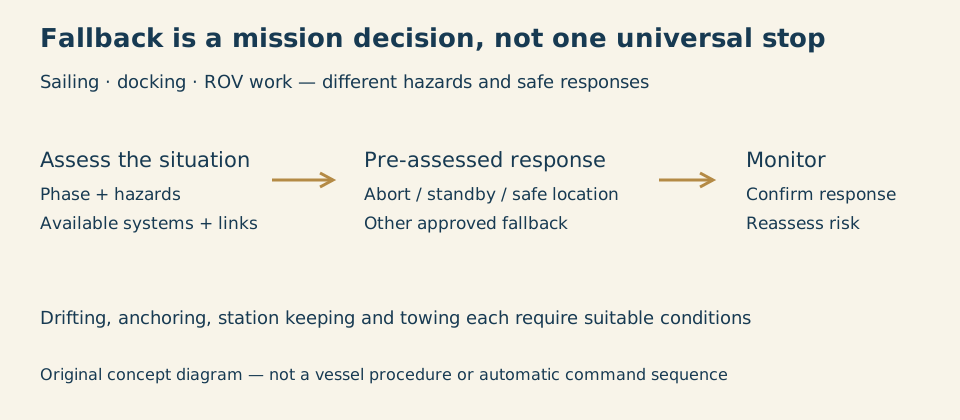
Choose and validate fallbacks for the actual mission and failure conditions. This is not an onboard procedure or an automatic command sequence.
5. Remote operations centres
A ROC is a Remote Operations Centre. The slides describe a Massterly concept with multiple workstations capable of monitoring and controlling vessels for different owners. This is a presented concept, not proof that any arbitrary number of vessels can safely be assigned to one operator.
Remote supervision needs clear responsibility, situational awareness, reliable communication, suitable workload and defined handover. Operators must understand what the vessel can do after a failure or loss of connection, and who is authorised to intervene. A normal-operation workload assessment alone is insufficient for simultaneous emergencies.
The source identifies ROC standards and remote-operator competence as challenges. Do not infer a universal staffing ratio or current certification requirement from these slides.
6. Approval is iterative
The presentation shows repeated plan → build → test → review cycles between a kickoff meeting and final approval. This illustrates a process of gathering evidence and resolving issues, rather than obtaining approval merely because a prototype completes a demonstration.
The NMA challenges listed include technology qualification, demonstrating equivalent safety, testing and validation methods, ROC arrangements, operator competence and the broad variety of concepts.
For the reader, distinguish:
- Design or preliminary approval from final operational approval.
- A controlled test area from unrestricted service.
- Commercial activity during testing from approval for fully uncrewed operation.
- An approved operating envelope from performance in every weather, traffic or failure condition.
7. Regulatory statements: historical snapshot, not current law
The slides describe a Norwegian approach using national rules and exemptions where necessary, and identify RSV 12-2020, guidelines for automated functions intended for unmanned or partially unmanned operations, based on IMO MSC.1/Circ.1455. They describe international operation in terms of possible SOLAS exemptions and equivalences and a future MASS Code.
They also refer to a recently co-signed North Sea MoU, case-by-case cross-border assessment, revision of RSV 12-2020 and implementation of a non-mandatory MASS Code as next steps. Those references do not establish their present completion or legal effect.
Before relying on a rule or approval: consult the current NMA and IMO publications and the vessel’s actual approval conditions. This lesson has not independently verified the current Code timetable, project approvals, cross-border agreements or revisions of Norwegian guidance. An MoU is not, by itself, permission for a specific vessel’s international voyage.
8. Connections to the library
- Maritime autonomy and remote operations: terminology and the historical UK consultation.
- Autonomous ships and safety at sea: whole-system assurance, people and cyber resilience.
- Maritime automation and monitoring: measurement, diagnosis and control boundaries.
- Dynamic Positioning fundamentals: station keeping and failure capability; DP is not equivalent to autonomous navigation.
- Digital twins for energy and offshore: virtual models support analysis but do not prove operational safety.
Self-test
- Are remote control and autonomous operation the same thing?
Answer 1 No. Remote operation locates control or supervision away from the vessel. Autonomy concerns functions and decisions performed by systems. Neither term alone establishes that a vessel is uncrewed.
- Does the presentation describe the Fjord1 concept as uncrewed?
Answer 2 No. It describes reduced crewing, no uncrewed operation, preliminary approval and four vessels for the Lavik–Oppedal service.
- Why should fallback states differ between sailing and ROV work?
Answer 3 The mission and hazards differ. ROV work may require recovery of the vehicle and management of its connection before standby; the safe response also depends on location and available systems.
- Is stopping always a safe fallback?
Answer 4 No. Traffic, drift, nearby structures and remaining manoeuvring capability can make a stop unsafe. The fallback must be pre-assessed for the mission and conditions.
- Name three Reach Remote fallback options reported in the slides.
Answer 5 Examples include limp home, abort and standby, moving to a predefined safe location, controlled drifting and anchoring. They are source-reported options, not universal instructions.
- Does a multi-workstation ROC imply that one operator can safely control any number of vessels?
Answer 6 No. Staffing and workload need assessment, including simultaneous abnormal conditions, situational awareness, communications and clear responsibilities.
- Does preliminary or design approval establish unrestricted uncrewed operational approval?
Answer 7 No. Approval stages and operating conditions differ. Testing, validation and final operational approval must be established for the actual vessel and mission.
- Can the slides’ “current” project and regulatory statements be treated as verified November 2026 status?
Answer 8 No. The presentation date was not established and present status was not independently verified. Consult current official publications and vessel-specific approvals.
Official organisations and source attribution
Primary source: Sifis Papageorgiou, Ongoing MASS projects in Norway, Norwegian Maritime Authority, 13-page uploaded presentation. Review date: 7 November 2026; presentation date not established. This is a source review, not a current regulatory verification.
Official organisations: Norwegian Maritime Authority and International Maritime Organization. These links identify the relevant authorities; they do not imply endorsement or verification of current project status. Source material is summarised in original wording; the slides and third-party photographs are not redistributed.